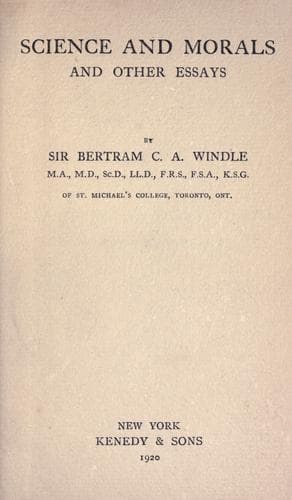
Science and Morals and Other EssaysWindle, Bertram Coghill Alan, Sir
Religion
Science and Morals and Other Essays
Windle, Bertram Coghill Alan, Sir
Essays; Religion and science; Science
John Turberville Needham (1713-1781) was born in London and belonged on
both sides to old Catholic families. He was educated at Douay and
ordained priest at Cambray in 1738. After teaching in that place for
some time he journeyed to England and became head-master of the once
celebrated school for Catholic boys at Twyford, near Winchester. From
there he went for a short time to Lisbon as professor of philosophy in
the English College. Subsequently he travelled with various Peers making
"the grand tour." After that he retired to Paris, where he was elected a
member of the _Academie des Sciences_. He was the first director of the
Imperial Academy in Brussels; a canon, first of Dendermonde and
afterward of Soignies. He died in Brussels and was buried in the Abbey
of Condenberg. Needham was a man of really great scientific attainments,
and perhaps nothing proves the estimation in which he was held more than
the fact that in 1746 he was elected a Fellow of the Royal Society,
being the first Catholic priest to become a member of that distinguished
body. When one remembers the attitude at that time, and much later, of
Englishmen towards Catholics it is clear that Needham's claims to
distinction must have been more than ordinarily great. His clear, firm
signature is still to be seen in the charter-book of the society, and it
is interesting to note that he signs his name "Turberville Needham."
Needham did not confine his attention to science, for he was an ardent
antiquary, and in 1761 was elected a Fellow of that other ancient and
exclusive body, the Society of Antiquaries of London. In this connection
it may be mentioned that Needham published, in 1761, a book which caused
a great sensation, for he endeavoured to show that he could translate an
Egyptian inscription by means of Chinese characters; in other words,
that the forms of writing were germane to one another. He was shown to
be quite wrong by some of the learned Jesuits of the day, who, with the
assistance of Chinese men of letters, proved that the resemblances to
which Needham had called attention were merely superficial.
Public-domain text, read in full here on John Shaqi.
Reviews
Reviews
No reviews yet
Be the first to share your thoughts on this work.
Elsewhere in the archive
Join the Discussion
Join the discussion
Sign in to leave a comment or review.
Sign InorCreate an account