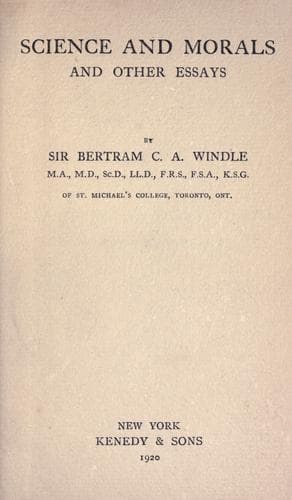
Science and Morals and Other EssaysWindle, Bertram Coghill Alan, Sir
Religion
Science and Morals and Other Essays
Windle, Bertram Coghill Alan, Sir
Essays; Religion and science; Science
But our interest now is in his controversy with Spallanzani. Lazaro
Spallanzani (1729-1799) was born at Scandiano in Modena and educated at
the Jesuit College at Reggio di Modena. There was some question as to
his entering the Society; he did not do so, however, but repaired to the
University of Bologna, where his kinswoman, Laura Bassi, was then
professor of physics. He became a priest, but devoted his life to
teaching and experimenting. He must have been something of what we in
Ireland used to call a "polymath," for he professed at one time or
another, in various universities, logic, metaphysics, Greek, and
finally natural history. He first explained the physics of what children
call "ducks and drakes" made by flat pebbles on water; laid the
foundations of meteorology and vulcanology, and is perhaps best of all
known in connection with what is termed "regeneration" in the earthworm
and above all in the salamander. His experiments still hold the field in
a region of study which has vastly extended itself in recent years,
becoming of prime importance in the vitalistic controversy.
In the dispute, however, with which we are concerned Needham and
Spallanzani defended opposite positions. The former, as the result of
his observations, asserted that, in spite of the boiling and sealing up
of organic fluids, life did appear in them. His opponent claimed that
Needham's experiments had not been sufficiently precise. The latter had
enclosed his fluids in bottles fitted with ordinary corks, covered with
mastic varnish, whilst Spallanzani, employing flasks with long necks
which he could and did seal by heat when the contents were boiling,
showed that in that case no life was produced. He declared, and
correctly too, as we now know, that Needham's methods did permit of the
introduction of something from without. The controversy went to sleep
again until the discovery of oxygen by Priestley in 1774. When it had
been shown that oxygen was essential to the existence of all forms of
life, the question arose as to whether the boiling of the organic fluids
in the earlier experiments had not expelled all the oxygen and thus
prevented the existence and development of any life.
Public-domain text, read in full here on John Shaqi.
Reviews
Reviews
No reviews yet
Be the first to share your thoughts on this work.
Elsewhere in the archive
Join the Discussion
Join the discussion
Sign in to leave a comment or review.
Sign InorCreate an account