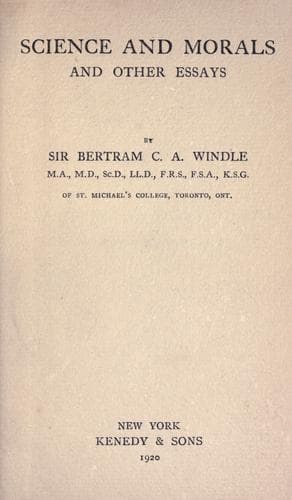
Science and Morals and Other EssaysWindle, Bertram Coghill Alan, Sir
Religion
Science and Morals and Other Essays
Windle, Bertram Coghill Alan, Sir
Essays; Religion and science; Science
In the further experiments which this query gave rise to, we meet with
another illustrious Catholic name, that of Theodor Schwann, better known
as the originator of that fundamental piece of scientific knowledge, the
cell-theory. Theodor Schwann (1810-1882) was born at Neuss and educated
by the Jesuits, first at Cologne, afterward at Bonn. After studying at
the Universities of Wuerzburg and Berlin he became professor in the
Catholic University of Louvain, where his name was one of the principal
glories of this now wrecked seat of learning. Thence he went as
professor to Liege, where he died. He was, says his biography in the
_Encyclopaedia Britannica_, "of a peculiarly gentle and amiable character
and remained a devout Catholic throughout his life." Schwann's
experiments tended to show that the introduction of air--of course
containing oxygen--did not lead to the production of life, if the air
had first been thoroughly sterilised. It was thought that this question
had been finally answered, when it was reopened by Pouchet, in 1859. He
was a Frenchman, the director of the Natural History Museum of Rouen,
but as to his religious views I have no information. It is quite
probable, however, that he was a Catholic. Pouchet and all on his side
were finally--so far as there can be finality in such a matter--disposed
of by Pasteur, of whose distinction as a man of science and devoutness
as a Catholic nothing need be said.
It is quite unnecessary to devote any consideration here to the
character of Pasteur's experiments, for they have become a matter of
common knowledge to all educated persons. Let it suffice to say that
they were on the lines first laid down by Redi and greatly elaborated by
Spallanzani, namely the exclusion from the fluids or other substances
under examination of all possible contamination by minute organisms in
the air. Spallanzani knew nothing of these organisms; they were not
discovered until many years after his death. But he surmised that there
was something which brought corruption into the fluids; he excluded that
something, with the result that the fluids remained untainted. From our
point of view, however, there are several things to be learnt. In the
first place quite a number of ignorant persons have thought that the
discovery of spontaneous generation would upset religious dogmata. That
of course is quite absurd. From what has been said above it will be seen
that St. Thomas Aquinas--in common with all the men of learning of his
day--fully believed in it, as did Needham, another ecclesiastic as to
whose orthodoxy there is no doubt. Further, the entire controversy is a
complete confutation of the false allegation that between Catholicism
and science there is a great gulf set. There have been few longer and
more remarkable controversies in the history of science, and scarce any
other--if indeed any other--which has such important bearings upon
health and industry than that which relates to bio- or abio-genesis. It
Public-domain text, read in full here on John Shaqi.
Reviews
Reviews
No reviews yet
Be the first to share your thoughts on this work.
Elsewhere in the archive
Join the Discussion
Join the discussion
Sign in to leave a comment or review.
Sign InorCreate an account