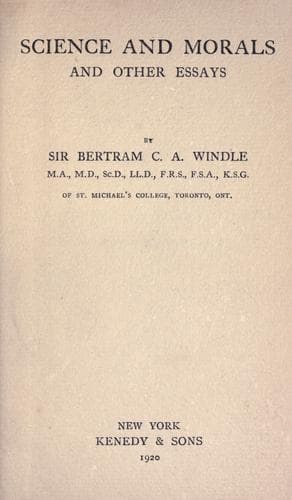
Science and Morals and Other EssaysWindle, Bertram Coghill Alan, Sir
Religion
Science and Morals and Other Essays
Windle, Bertram Coghill Alan, Sir
Essays; Religion and science; Science
Or again: "So far as the _creative_ power of energy is concerned, we are
on sure ground." The author has a careful note on the word creation (p.
5), "the production of something new out of nothing," under which
definition it is abundantly clear that energy, whilst it may be
_productive_, cannot be _creative_. In fact, nothing can be _creative_
in any definite and rigid sense, save a _Creator_ Who existed from all
eternity and from Whom all things arose. One more instance of loose
argumentation, and we can turn to the main purport of the book. It is a
link in the author's "chain" which cannot be passed without examination.
Everybody is familiar with the method of proof by elimination. We set
down every possible explanation of a certain occurrence; we rule out one
after the other until but one is left. If we really have set down all
the possible explanations, and if we are quite clear as to the fact that
all those which have been excluded are legitimately put out of court,
then the one remaining explanation must be the true one. It is a method
of proof which has frequently been applied to the vitalistic problem,
and with the greatest effect, as it is admitted by some of those who
would greatly like to find a materialistic explanation for that problem
(cf. _The Philosophy of Biology_, Johnstone, p. 319).
Let us see how our author employs it. What, he asks, is "the internal
moving principle" in living substance? And he replies: "We may first
exclude the possibility that it acts either through supernatural or
teleological interposition through an externally creative power." Very
well! Philosophers tell us that we can assume any position we choose for
the purposes of our argument, but that ultimately we must prove that
assumption or admit ourselves beaten. We look anxiously for the proof of
the assumption made by our author, but absolutely no attempt is made to
give one. We must be pardoned, therefore, if we hesitate to accept such
an important statement on his mere _ipse dixit_. We pass on to the next
elimination: "Although its visible results are in a high degree
purposeful, we may also exclude as unscientific the vitalistic theory of
an _entelechy_[37] or any other form of internal perfecting agency
distinct from known or unknown physio-chemical energies." Why
"unscientific"? Numbers of high authorities have not thought it so; and
in quite recent years such eminent writers as Driesch and McDougal have
written erudite works to prove this "unscientific" hypothesis. Is there
any proof brought forward for _this_ assertion and its corresponding
elimination?
Public-domain text, read in full here on John Shaqi.
Reviews
Reviews
No reviews yet
Be the first to share your thoughts on this work.
Elsewhere in the archive
Join the Discussion
Join the discussion
Sign in to leave a comment or review.
Sign InorCreate an account