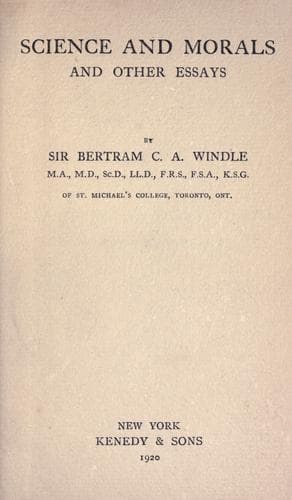
Science and Morals and Other EssaysWindle, Bertram Coghill Alan, Sir
Religion
Science and Morals and Other Essays
Windle, Bertram Coghill Alan, Sir
Essays; Religion and science; Science
Let us continue the quotation: "Since certain forms of adaptation which
were formerly mysterious can now be explained without the assumption of
an entelechy we are encouraged to hope that all forms may be thus
explained." The author does not tell us what the mysterious adaptations
are, nor does he offer us the explanations which, in his opinion,
explain them. We cannot, therefore, criticise his views, and can only
remind his readers that, because an explanation plausibly explains an
occurrence, it is by no means always therefore certain to be the true
explanation; it may, indeed, be wholly false.
Further, those who have been wandering for the past half-century in the
fields of science have become a little wearied of "explanations,"
vaunted, for periods of five or ten years, as the key to open all locks,
and then cast into the furnace. What the author would seem to mean by
his statement is this: "I am convinced myself that we can do without a
'supernatural' explanation, and I regard as 'unscientific' any
explanation which cannot be put to the test of chemistry and physics;
hence I must shut the door on anything like an _entelechy_, and, that
being so, it behoves me to look for some other explanation." Of course,
we are putting these words into the mouth of our author; if we were
dealing with the matter ourselves we should be inclined to argue that,
by the eliminatory method, chemistry and physics do prove, or do help to
prove, the existence of an entelechy.
With these expostulations we may turn to the writer's pronouncements on
the vitalistic question which seem to us to be worthy of serious
consideration. Everybody knows that there are two very diverse opinions
on this topic; the one that there is, the other that there is not
something more--a _plus_--in living than there is in not-living
objects. In other words, that there is a difference of kind, and not
merely of degree, between a stone and a sparrow. Hence the schools of
thought called vitalistic and mechanistic. To most persons it has up to
now seemed impossible that there could be a third school; we appeared to
be confronted with what the logicians call a Dichotomy. Professor Osborn
seems to us to think otherwise, though he is not wholly clear on this
matter. If we are to "reject the vitalistic hypotheses of the ancient
Greeks, and the modern vitalism of Driesch, of Bergson, and of others,"
and if, on the other hand, we are to view, as he thinks we must, the
cosmos as one of "limitless and _ordered_ energy"--we have emphasised
the word "_ordered_" for reasons which will shortly appear--we must
clearly look out for some middle way. "_Ordered_," a purely mechanistic
and materialistically realised cosmos cannot be. "_Ordered_" conditions
are determined by what we agree to call "Laws"; and these, as all must
admit, entail a Lawgiver.
Public-domain text, read in full here on John Shaqi.
Reviews
Reviews
No reviews yet
Be the first to share your thoughts on this work.
Elsewhere in the archive
Join the Discussion
Join the discussion
Sign in to leave a comment or review.
Sign InorCreate an account