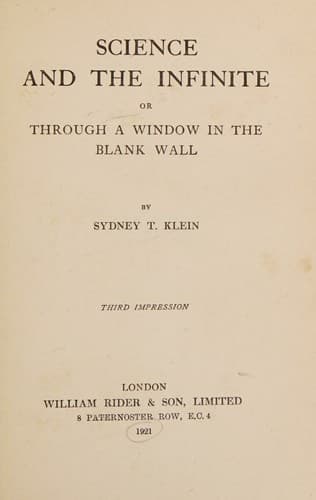
Science and the Infinite; or, Through a Window in the Blank WallKlein, Sydney T. (Sydney Turner)
Religion
Science and the Infinite; or, Through a Window in the Blank Wall
Klein, Sydney T. (Sydney Turner)
Religion and science
I have already pointed out in View Two that the Transcendental
Personality, being Spiritual, and therefore akin to the Great Reality,
may be said to have no free-will of itself. Its will or influence must
always be working towards perfection in the form "Let Thy Will, which
is also my will, be done"; the efficacy of its influence with the
Great Reality depends on its growth or nourishment by the knowledge of
the Good, Beautiful, and True ever bringing it more and more nearly
into perfect touch or sympathy with the All-loving. The power of
prayer therefore depends upon two conditions; it must be in the form
of "Let thy Will be done," and that which prays must be capable of
making its petition felt, by having already gained a knowledge of what
that Will is. I am, of course, not referring to that form of prayer
which, alas with so many, seems to be the attempt to get as much out
of the Absolute as is possible, with the least amount of trouble.
If now we carefully examine the Phenomena around us, we make the
extraordinary discovery that this power to influence is the very basis
of survival and of progress throughout the universe. In the organic
world all Nature seems to be praying in one form or another, and only
those that pray with efficacy, based upon the above two conditions,
survive in the struggle for existence. The economy of Nature is
founded upon that inexorable law the "Survival of the Fittest"; every
organism that is not in sympathy with its environment, and cannot
therefore derive help and nourishment from its surroundings, perishes.
Darwin tells us that the colours of flowering plants have been
developed by the necessity of attracting the bees, on whose visits
depends the power of plants to reproduce their species; those families
of plants which do not as it were pray to the bees with efficacy, fail
to attract, are not therefore fertilised, and disappear without
leaving successors. Flowers may also be said to be praying to us by
their beauty, or usefulness, and in some cases, as with orchids, by
their marvellous shapes. We answer their prayer by building hot houses
and tending them with care, because they please us, and therefore we
help them to live; while, on the contrary, those plants that have not
developed these qualities are not only neglected, but, in some cases,
as with weeds, we take special trouble to exterminate them, because
their existence is distasteful to us.
Public-domain text, read in full here on John Shaqi.
Reviews
Reviews
No reviews yet
Be the first to share your thoughts on this work.
Join the Discussion
Join the discussion
Sign in to leave a comment or review.
Sign InorCreate an account