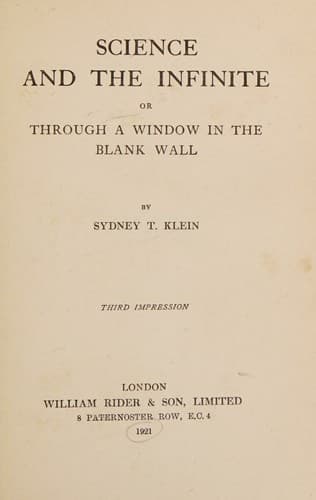
Science and the Infinite; or, Through a Window in the Blank Wall — John Shaqi
Science and the Infinite; or, Through a Window in the Blank WallKlein, Sydney T. (Sydney Turner)
Religion
Science and the Infinite; or, Through a Window in the Blank Wall
Klein, Sydney T. (Sydney Turner)
Religion and science
traits, I can make that mass demonstrate them both optically and
audibly; but, without those special sympathetic touches, it is silent
and remains an inert mass. This result is obtained by physical contact
between the instrument and the mass, but we will now carry this
another step forward and deal with the subject of the action of
Influence at a distance, or what may be called Prayer, between two of
these rigid masses. From what we have already seen, it is clear that
the Soul of man could not possibly pray with efficacy to a graven
image; there is nothing in sympathy between them, and, without
sympathetic action, influence is impossible; but it is quite possible
for Matter to pray with efficacy to Matter, provided the material
soul, if we may use the analogy, is brought into perfect sympathy with
the material god, and I can now put before you an experiment showing
this taking place.
I have another heavy bar of iron, not so long but of the same
thickness as the one already described, and have found its strongest
characteristic; I have another small rubber, fashioned so that its
characteristic is in perfect sympathy with that of the bar, namely,
that the number of vibrations, in a second, of the instrument are
exactly equal to those of the iron mass, and it is, therefore, as we
saw in the last experiment, able by contact to influence the bar
sympathetically. The slightest touch throws the bar into such violent
vibration that a great volume of sound is produced, which can be heard
a quarter of a mile away. The result of this sympathetic touch is far
from being transient, in fact, the bar will continue to move, audibly,
for a long time. This movement in the mass of iron was started by
physical contact, but having once started the bar praying, willing, or
thinking, whichever you like to call it, that bar now has the power to
affect, without contact, another rigid bar of iron even when removed
to great distances, provided the second bar possesses a similar
characteristic, and that that characteristic has been brought into
perfect _sympathy_ with that of the first bar. I have a second bar
which fulfils these conditions, and, although, at the outset, it had
no power whatever to respond, it has been gradually, as it were,
educated, namely, brought nearer and nearer into sympathy with the
first bar, until it is now able to respond across long distances; it
has acted across the whole length of one of the largest halls in
London so strongly that it could be heard by all present. We will now
reverse the process of bringing these bars into sympathy, and I will
throw the first out of harmony by slightly changing its
characteristic; the change is extremely small, quite inappreciable to
the human ear, the bar giving out as full and pure a note as it did
before the alteration was made; in fact, the change is so slight that
it can still, with a little force, be stimulated by the same
generator, and yet the whole power to influence has been lost; the
Public-domain text, read in full here on John Shaqi.
Reviews
Reviews
No reviews yet
Be the first to share your thoughts on this work.
Join the Discussion
Join the discussion
Sign in to leave a comment or review.
Sign InorCreate an account