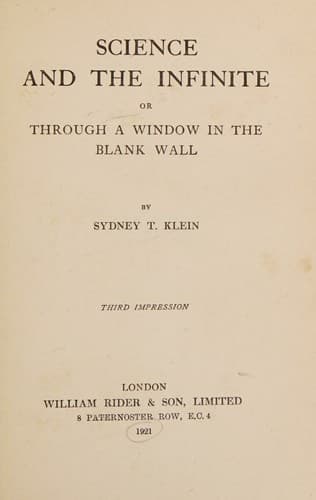
Science and the Infinite; or, Through a Window in the Blank WallKlein, Sydney T. (Sydney Turner)
Religion
Science and the Infinite; or, Through a Window in the Blank Wall
Klein, Sydney T. (Sydney Turner)
Religion and science
still go on further by the help of Science: beyond the violet we have
the actinic or chemical rays, which are used in photography, and which
enable us to trace the frequencies for a further two octaves. Beyond
this we cannot pierce with our present knowledge; but there may be,
and probably are, latent in our nature, senses which, properly
developed, will be able to appreciate still more subtle vibrations,
and organs which, perhaps, even now are being prepared for the
reception of these influences.
We have no organs yet developed for receiving and appreciating what
are called Wireless waves, but we have already been able to devise
physical Receivers, of wonderful sensitiveness, for them and other
waves of the same nature, such as those of Radiant heat. In the case
of Radiant heat, the Bolometer invented by Professor Langley has been
able to receive and record a change of temperature of the one
millionth of a degree Centigrade, and can easily make visible the heat
of a candle at a distance of one and a half miles. In wireless
telegraphy also the Receiver, perfected by Marconi, is affected by
rills, made by a splash of electric discharge, over 3000 miles away.
If our eyes were sensitive to these frequencies, both of which are
composed, as is also light, of electro-magnetic rills, we could see
anything that was happening anywhere in the world, for they go through
matter as though it did not exist, as light passes through glass;
indeed, if our region of Sight waves was only put an octave lower we
could not use glass in our windows, it would be too opaque, we should
be obliged to have our windows made of thin slabs of carbon or other
substances permeable to Radiant heat waves. Science indeed steadily
points to electricity and magnetism being a form of motion, and it may
be that in these invisible rays we may some day discover the nature
of those mysterious forces; and, even far beyond those, as suggested
in View Four, we may in the not far distant future be able to
appreciate Physical Life itself as a mode of frequency.
Public-domain text, read in full here on John Shaqi.
Reviews
Reviews
No reviews yet
Be the first to share your thoughts on this work.
Elsewhere in the archive
Join the Discussion
Join the discussion
Sign in to leave a comment or review.
Sign InorCreate an account