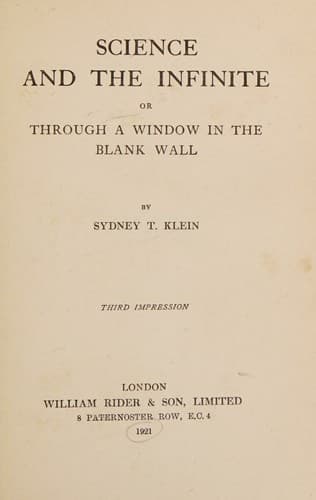
Science and the Infinite; or, Through a Window in the Blank WallKlein, Sydney T. (Sydney Turner)
Religion
Science and the Infinite; or, Through a Window in the Blank Wall
Klein, Sydney T. (Sydney Turner)
Religion and science
We want, as it were, a special "Time Microscope," which I have already
referred to, to examine these vibrations, and a method similar to that
already mentioned in "Space," under Celestial Photography, by which we
may traverse and examine hundreds or thousands of octaves by each
second of exposure; for, although the path extends to infinity, we
have already arrived at the utmost limits of our finite senses, and
find that after all we can only appreciate fifty-one octaves, a few
inches only, as it were, along the line of Infinite extent, reaching
from the finite up to the Reality; and even so it must be borne in
mind that we have only travelled in one direction, whereas the path we
have taken extends in the opposite direction also to infinity. We
started with sixteen vibrations in a second, as the lowest number of
beats we human beings can appreciate as a musical sound; let us now
descend by octaves. The octave below is eight vibrations in a second,
and there are probably many animals that can only hear these as a
musical sound; the next octave is four, then two, and then one
vibration in a second. But we do not stop there; the octave below
this is one vibration in two seconds, then in four seconds, eight
seconds, sixteen seconds, and so on, until it is possible to conceive
that even one frequency in a million years might be appreciated as a
musical sound, or even as one of the colours of the spectrum, by a
being whose time sensations were enormously extended in both
directions, but still finite.
Once more we must call a halt. Our finite minds become bewildered in
attempting even to glance at these infinities of time.
We measure space by miles, yards, feet, and inches; we measure time by
years, hours, minutes, and seconds; and by these finite units we try
to fathom these two marvellous infinities. With our greatest efforts
of thought we find, however, that we can get relatively no distance
whatever from the HERE of Space and the NOW of Time. It is true that
the present, as a mathematical point, appears to be hurrying and
bearing us with it along the line stretching from the past to future
eternity, but in reality we get no further from the one nor nearer to
the other. Let us change our view and examine this subject under a
different aspect.
Public-domain text, read in full here on John Shaqi.
Reviews
Reviews
No reviews yet
Be the first to share your thoughts on this work.
Elsewhere in the archive
Join the Discussion
Join the discussion
Sign in to leave a comment or review.
Sign InorCreate an account