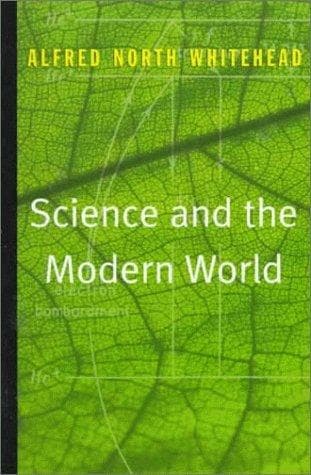
Science and the modern worldWhitehead, Alfred North
Religion
Science and the modern world
Whitehead, Alfred North
Science
It looks at first sight, as if a physical object, with its process of
inheritance from itself, were independent of the environment. But such a
conclusion is not justified. For let B and C be two successive slices in
the life of such an object, such that C succeeds B. Then the enduring
pattern in C is inherited from B, and from other analogous antecedent
parts of its life. It is transmitted through B to C. But what is
transmitted to C is the complete pattern of aspects derived from such
events as B. These complete patterns include the influence of the
environment on B, and on the other antecedent parts of the life of the
object. Thus the complete aspects of the antecedent life are inherited
as the partial pattern which endures throughout all the various periods
of the life. Thus a favourable environment is essential to the
maintenance of a physical object.
Nature, as we know it, comprises enormous permanences. There are the
permanences of ordinary matter. The molecules within the oldest rocks
known to geologists may have existed unchanged for over a thousand
million years, not only unchanged in themselves, but unchanged in their
relative dispositions to each other. In that length of time the number
of pulsations of a molecule vibrating with the frequency of yellow
sodium light would be about 16.3 × 10^{22} = 163,000 × (10^6)³. Until
recently, an atom was apparently indestructible. We know better now. But
the indestructible atom has been succeeded by the apparently
indestructible electron and the indestructible proton.
Another fact to be explained is the great similarity of these
practically indestructible objects. All electrons are very similar to
each other. We need not outrun the evidence, and say that they are
identical; but our powers of observation cannot detect any differences.
Analogously, all hydrogen nuclei are alike. Also we note the great
numbers of these analogous objects. There are throngs of them. It seems
as though a certain similarity were a favourable condition for
endurance. Common sense also suggests this conclusion. If organisms are
to survive, they must work together.
Accordingly, the key to the mechanism of evolution is the necessity for
the evolution of a favourable environment, conjointly with the evolution
of any specific type of enduring organisms of great permanence. Any
physical object which by its influence deteriorates its environment,
commits suicide.
Public-domain text, read in full here on John Shaqi.
Reviews
Reviews
No reviews yet
Be the first to share your thoughts on this work.
Elsewhere in the archive
Join the Discussion
Join the discussion
Sign in to leave a comment or review.
Sign InorCreate an account