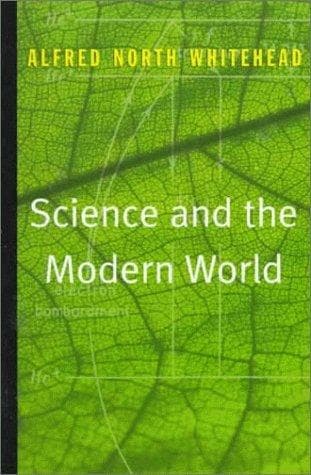
Science and the modern worldWhitehead, Alfred North
Religion
Science and the modern world
Whitehead, Alfred North
Science
The point to be made for the purposes of the present discussion is that
a philosophy of nature as organic must start at the opposite end to that
requisite for a materialistic philosophy. The materialistic starting
point is from independently existing substances, matter and mind. The
matter suffers modifications of its external relations of locomotion,
and the mind suffers modifications of its contemplated objects. There
are, in this materialistic theory, two sorts of independent substances,
each qualified by their appropriate passions. The organic starting point
is from the analysis of process as the realisation of events disposed in
an interlocked community. The event is the unit of things real. The
emergent enduring pattern is the stabilisation of the emergent
achievement so as to become a fact which retains its identity throughout
the process. It will be noted that endurance is not primarily the
property of enduring beyond itself, but of enduring within itself. I
mean that endurance is the property of finding its pattern reproduced in
the temporal parts of the total event. It is in this sense that a total
event carries an enduring pattern. There is an intrinsic value identical
for the whole and for its succession of parts. Cognition is the
emergence, into some measure of individualised reality, of the general
substratum of activity, poising before itself possibility, actuality,
and purpose.
It is equally possible to arrive at this organic conception of the world
if we start from the fundamental notions of modern physics, instead of,
as above, from psychology and physiology. In fact by reason of my own
studies in mathematics and mathematical physics, I did in fact arrive at
my convictions in this way. Mathematical physics presumes in the first
place an electromagnetic field of activity pervading space and time. The
laws which condition this field are nothing else than the conditions
observed by the general activity of the flux of the world, as it
individualises itself in the events. In physics, there is an
abstraction. The science ignores what anything is in itself. Its
entities are merely considered in respect to their extrinsic reality,
that is to say, in respect to their aspects in other things. But the
abstraction reaches even further than that; for it is only the aspects
in other things, as modifying the spatio-temporal specifications of the
life histories of those other things, which count. The intrinsic reality
of the observer comes in: I mean what the observer is for himself is
appealed to. For example, the fact that he will see red or blue enters
into scientific statements. But the red which the observer sees does not
in truth enter into science. What is relevant is merely the bare
diversity of the observer’s red experiences from all of his other
experiences. Accordingly, the intrinsic character of the observer is
merely relevant in order to fix the self-identical individuality of the
physical entities.
Public-domain text, read in full here on John Shaqi.
Reviews
Reviews
No reviews yet
Be the first to share your thoughts on this work.
Elsewhere in the archive
Join the Discussion
Join the discussion
Sign in to leave a comment or review.
Sign InorCreate an account