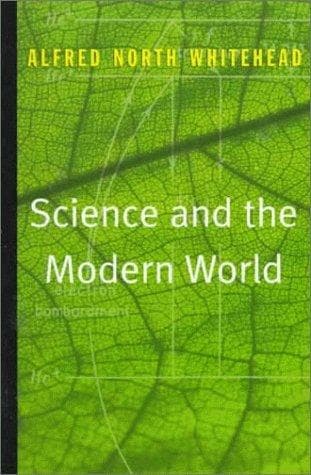
Science and the modern worldWhitehead, Alfred North
Religion
Science and the modern world
Whitehead, Alfred North
Science
What I mean is art and aesthetic education. It is, however, art in such
a general sense of the term that I hardly like to call it by that name.
Art is a special example. What we want is to draw out habits of
aesthetic apprehension. According to the metaphysical doctrine which I
have been developing, to do so is to increase the depth of
individuality. The analysis of reality indicates the two factors,
activity emerging into individualised aesthetic value. Also the emergent
value is the measure of the individualisation of the activity. We must
foster the creative initiative towards the maintenance of objective
values. You will not obtain the apprehension without the initiative, or
the initiative without the apprehension. As soon as you get towards the
concrete, you cannot exclude action. Sensitiveness without impulse
spells decadence, and impulse without sensitiveness spells brutality. I
am using the word “sensitiveness” in its most general signification, so
as to include apprehension of what lies beyond oneself; that is to say,
sensitiveness to all the facts of the case. Thus “art” in the general
sense which I require is any selection by which the concrete facts are
so arranged as to elicit attention to particular values which are
realisable by them. For example, the mere disposing of the human body
and the eyesight so as to get a good view of a sunset is a simple form
of artistic selection. The habit of art is the habit of enjoying vivid
values.
But, in this sense, art concerns more than sunsets. A factory, with its
machinery, its community of operatives, its social service to the
general population, its dependence upon organising and designing genius,
its potentialities as a source of wealth to the holders of its stock is
an organism exhibiting a variety of vivid values. What we want to train
is the habit of apprehending such an organism in its completeness. It is
very arguable that the science of political economy, as studied in its
first period after the death of Adam Smith (1790), did more harm than
good. It destroyed many economic fallacies, and taught how to think
about the economic revolution then in progress. But it riveted on men a
certain set of abstractions which were disastrous in their influence on
modern mentality. It de-humanised industry. This is only one example of
a general danger inherent in modern science. Its methodological
procedure is exclusive and intolerant, and rightly so. It fixes
attention on a definite group of abstractions, neglects everything else,
and elicits every scrap of information and theory which is relevant to
what it has retained. This method is triumphant, provided that the
abstractions are judicious. But, however triumphant, the triumph is
within limits. The neglect of these limits leads to disastrous
oversights. The anti-rationalism of science is partly justified, as a
preservation of its useful methodology; it is partly mere irrational
prejudice.
Public-domain text, read in full here on John Shaqi.
Reviews
Reviews
No reviews yet
Be the first to share your thoughts on this work.
Elsewhere in the archive
Join the Discussion
Join the discussion
Sign in to leave a comment or review.
Sign InorCreate an account