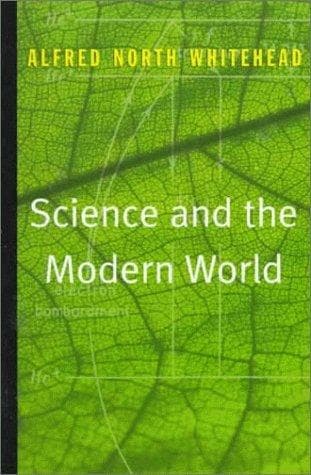
Science and the modern worldWhitehead, Alfred North
Religion
Science and the modern world
Whitehead, Alfred North
Science
Modern professionalism is the training of minds to conform to
the methodology. The historical revolt of the seventeenth century, and
the earlier reaction towards naturalism, were examples of transcending
the abstractions which fascinated educated society in the Middle Ages.
These early ages had an ideal of rationalism, but they failed in its
pursuit. For they neglected to note that the methodology of reasoning
requires the limitations involved in the abstract. Accordingly, the true
rationalism must always transcend itself by recurrence to the concrete
in search of inspiration. A self-satisfied rationalism is in effect a
form of anti-rationalism. It means an arbitrary halt at a particular set
of abstractions. This was the case with science.
There are two principles inherent in the very nature of things,
recurring in some particular embodiments whatever field we explore—the
spirit of change, and the spirit of conservation. There can be nothing
real without both. Mere change without conservation is a passage from
nothing to nothing. Its final integration yields mere transient
non-entity. Mere conservation without change cannot conserve. For after
all, there is a flux of circumstance, and the freshness of being
evaporates under mere repetition. The character of existent reality is
composed of organisms enduring through the flux of things. The low type
of organisms have achieved a self-identity dominating their whole
physical life. Electrons, molecules, crystals, belong to this type. They
exhibit a massive and complete sameness. In the higher types, where life
appears, there is greater complexity. Thus, though there is a complex,
enduring pattern, it has retreated into deeper recesses of the total
fact. In a sense, the self-identity of a human being is more abstract
than that of a crystal. It is the life of the spirit. It relates rather
to the individualisation of the creative activity; so that the changing
circumstances received from the environment, are differentiated from the
living personality, and are thought of as forming its perceived field.
In truth, the field of perception and the perceiving mind are
abstractions which, in the concrete, combine into the successive bodily
events. The psychological field, as restricted to sense-objects and
passing emotions, is the minor permanence, barely rescued from the
nonentity of mere change; and the mind is the major permanence,
permeating that complete field, whose endurance is the living soul. But
the soul would wither without fertilisation from its transient
experiences. The secret of the higher organisms lies in their two grades
of permanences. By this means the freshness of the environment is
absorbed into the permanence of the soul. The changing environment is no
longer, by reason of its variety, an enemy to the endurance of the
organism. The pattern of the higher organism has retreated into the
recesses of the individualised activity. It has become a uniform way of
Public-domain text, read in full here on John Shaqi.
Reviews
Reviews
No reviews yet
Be the first to share your thoughts on this work.
Elsewhere in the archive
Join the Discussion
Join the discussion
Sign in to leave a comment or review.
Sign InorCreate an account