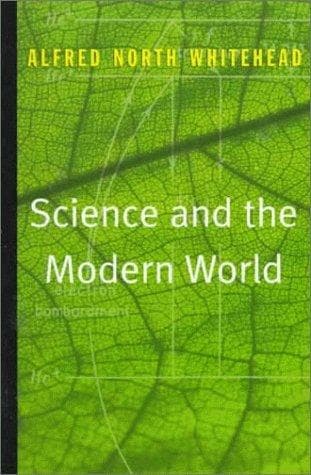
Science and the modern worldWhitehead, Alfred North
Religion
Science and the modern world
Whitehead, Alfred North
Science
The progress of science has now reached a turning point. The stable
foundations of physics have broken up: also for the first time
physiology is asserting itself as an effective body of knowledge, as
distinct from a scrap-heap. The old foundations of scientific thought
are becoming unintelligible. Time, space, matter, material, ether,
electricity, mechanism, organism, configuration, structure, pattern,
function, all require reinterpretation. What is the sense of talking
about a mechanical explanation when you do not know what you mean by
mechanics?
The truth is that science started its modern career by taking over ideas
derived from the weakest side of the philosophies of Aristotle’s
successors. In some respects it was a happy choice. It enabled the
knowledge of the seventeenth century to be formularised so far as
physics and chemistry were concerned, with a completeness which has
lasted to the present time. But the progress of biology and psychology
has probably been checked by the uncritical assumption of half-truths.
If science is not to degenerate into a medley of _ad hoc_ hypotheses, it
must become philosophical and must enter upon a thorough criticism of
its own foundations.
In the succeeding lectures of this course, I shall trace the successes
and the failures of the particular conceptions of cosmology with which
the European intellect has clothed itself in the last three centuries.
General climates of opinion persist for periods of about two to three
generations, that is to say, for periods of sixty to a hundred years.
There are also shorter waves of thought, which play on the surface of
the tidal movement. We shall find, therefore, transformations in the
European outlook, slowly modifying the successive centuries. There
persists, however, throughout the whole period the fixed scientific
cosmology which presupposes the ultimate fact of an irreducible brute
matter, or material, spread throughout space in a flux of
configurations. In itself such a material is senseless, valueless,
purposeless. It just does what it does do, following a fixed routine
imposed by external relations which do not spring from the nature of its
being. It is this assumption that I call ‘scientific materialism.’ Also
it is an assumption which I shall challenge as being entirely unsuited
to the scientific situation at which we have now arrived. It is not
wrong, if properly construed. If we confine ourselves to certain types
of facts, abstracted from the complete circumstances in which they
occur, the materialistic assumption expresses these facts to perfection.
But when we pass beyond the abstraction, either by more subtle
employment of our senses, or by the request for meanings and for
coherence of thoughts, the scheme breaks down at once. The narrow
efficiency of the scheme was the very cause of its supreme
methodological success. For it directed attention to just those groups
of facts which, in the state of knowledge then existing, required
investigation.
Public-domain text, read in full here on John Shaqi.
Reviews
Reviews
No reviews yet
Be the first to share your thoughts on this work.
Join the Discussion
Join the discussion
Sign in to leave a comment or review.
Sign InorCreate an account