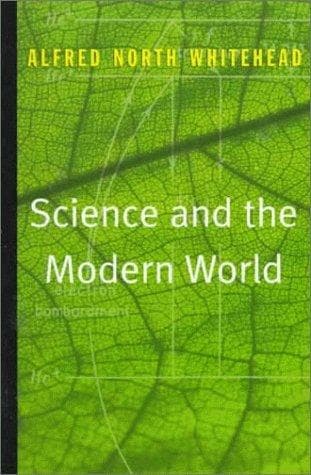
Science and the modern worldWhitehead, Alfred North
Religion
Science and the modern world
Whitehead, Alfred North
Science
Bearing this in mind, I have avoided the introduction of a variety of
abstruse detail respecting scientific advance. What is wanted, and what
I have striven after, is a sympathetic study of main ideas as seen from
the inside. If my view of the function of philosophy is correct, it is
the most effective of all the intellectual pursuits. It builds
cathedrals before the workmen have moved a stone, and it destroys them
before the elements have worn down their arches. It is the architect of
the buildings of the spirit, and it is also their solvent:—and the
spiritual precedes the material. Philosophy works slowly. Thoughts lie
dormant for ages; and then, almost suddenly as it were, mankind finds
that they have embodied themselves in institutions.
This book in the main consists of a set of eight Lowell Lectures
delivered in the February of 1925. These lectures with some slight
expansion, and the subdivision of one lecture into Chapters VII and
VIII, are here printed as delivered. But some additional matter has
been added, so as to complete the thought of the book on a scale which
could not be included within that lecture course. Of this new matter,
the second chapter—‘Mathematics as an Element in the History of
Thought’—was delivered as a lecture before the Mathematical Society of
Brown University, Providence, R. I.; and the twelfth chapter—‘Religion
and Science’—formed an address delivered in the Phillips Brooks House
at Harvard, and is to be published in the August number of the
_Atlantic Monthly_ of this year (1925). The tenth and eleventh
chapters—‘Abstraction’ and ‘God’—are additions which now appear for
the first time. But the book represents one train of thought, and the
antecedent utilisation of some of its contents is a subsidiary point.
There has been no occasion in the text to make detailed reference to
Lloyd Morgan’s _Emergent Evolution_ or to Alexander’s _Space, Time and
Deity_. It will be obvious to readers that I have found them very
suggestive. I am especially indebted to Alexander’s great work. The wide
scope of the present book makes it impossible to acknowledge in detail
the various sources of information or of ideas. The book is the product
of thought and reading in past years, which were not undertaken with any
anticipation of utilisation for the present purpose. Accordingly it
would now be impossible for me to give reference to my sources for
details, even if it were desirable so to do. But there is no need: the
facts which are relied upon are simple and well known. On the
philosophical side, any consideration of epistemology has been entirely
excluded. It would have been impossible to discuss that topic without
upsetting the whole balance of the work. The key to the book is the
sense of the overwhelming importance of a prevalent philosophy.
My most grateful thanks are due to my colleague Mr. Raphael Demos for
reading the proofs and for the suggestion of many improvements in
expression.
Public-domain text, read in full here on John Shaqi.
Reviews
Reviews
No reviews yet
Be the first to share your thoughts on this work.
Join the Discussion
Join the discussion
Sign in to leave a comment or review.
Sign InorCreate an account