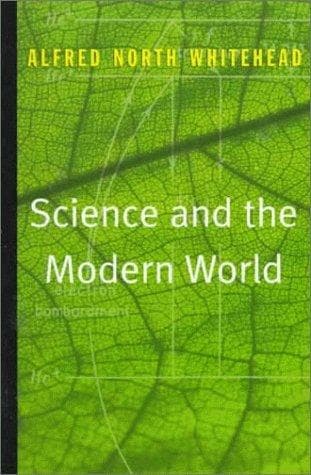
Science and the modern worldWhitehead, Alfred North
Religion
Science and the modern world
Whitehead, Alfred North
Science
This usage was first employed in equations, which are methods of asking
complicated arithmetical questions. In this connection, the letters
representing numbers were termed ‘unknowns.’ But equations soon
suggested a new idea, that, namely, of a function of one or more general
symbols, these symbols being letters representing any numbers. In this
employment the algebraic letters are called the ‘arguments’ of the
function, or sometimes they are called the ‘variables.’ Then, for
instance, if an angle is represented by an algebraical letter, as
standing for its numerical measure in terms of a given unit,
Trigonometry is absorbed into this new algebra. Algebra thus develops
into the general science of analysis in which we consider the properties
of various functions of undetermined arguments. Finally the particular
functions, such as the trigonometrical functions, and the logarithmic
functions, and the algebraic functions, are generalised into the idea of
‘any function.’ Too large a generalisation leads to mere barrenness. It
is the large generalisation, limited by a happy particularity, which is
the fruitful conception. For instance the idea of any _continuous_
function, whereby the limitation of continuity is introduced, is the
fruitful idea which has led to most of the important applications. This
rise of algebraic analysis was concurrent with Descartes’ discovery of
analytical geometry, and then with the invention of the infinitesimal
calculus by Newton and Leibniz. Truly, Pythagoras, if he could have
foreseen the issue of the train of thought which he had set going would
have felt himself fully justified in his brotherhood with its excitement
of mysterious rites.
The point which I now want to make is that this dominance of the idea of
functionality in the abstract sphere of mathematics found itself
reflected in the order of nature under the guise of mathematically
expressed laws of nature. Apart from this progress of mathematics, the
seventeenth century developments of science would have been impossible.
Mathematics supplied the background of imaginative thought with which
the men of science approached the observation of nature. Galileo
produced formulae, Descartes produced formulae, Huyghens produced
formulae, Newton produced formulae.
As a particular example of the effect of the abstract development of
mathematics upon the science of those times, consider the notion of
periodicity. The general recurrences of things are very obvious in our
ordinary experience. Days recur, lunar phases recur, the seasons of the
year recur, rotating bodies recur to their old positions, beats of the
heart recur, breathing recurs. On every side, we are met by recurrence.
Apart from recurrence, knowledge would be impossible; for nothing could
be referred to our past experience. Also, apart from some regularity of
recurrence, measurement would be impossible. In our experience, as we
gain the idea of exactness, recurrence is fundamental.
Public-domain text, read in full here on John Shaqi.
Reviews
Reviews
No reviews yet
Be the first to share your thoughts on this work.
Join the Discussion
Join the discussion
Sign in to leave a comment or review.
Sign InorCreate an account