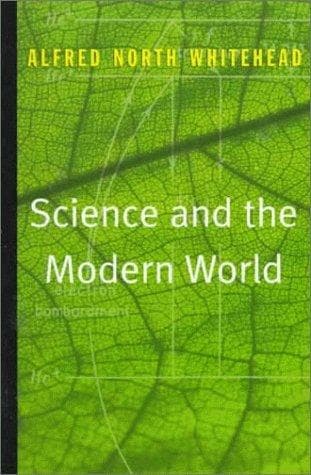
Science and the modern worldWhitehead, Alfred North
Religion
Science and the modern world
Whitehead, Alfred North
Science
Another contrast which singles out science from among the European
movements of the sixteenth and seventeenth centuries, is its
universality. Modern science was born in Europe, but its home is the
whole world. In the last two centuries there has been a long and
confused impact of Western modes upon the civilisation of Asia. The wise
men of the East have been puzzling, and are puzzling, as to what may be
the regulative secret of life which can be passed from West to East
without the wanton destruction of their own inheritance which they so
rightly prize. More and more it is becoming evident that what the West
can most readily give to the East is its science and its scientific
outlook. This is transferable from country to country, and from race to
race, wherever there is a rational society.
In this course of lectures I shall not discuss the details of scientific
discovery. My theme is the energising of a state of mind in the modern
world, its broad generalisations, and its impact upon other spiritual
forces. There are two ways of reading history, forwards and backwards.
In the history of thought, we require both methods. A climate of
opinion—to use the happy phrase of a seventeenth century writer—requires
for its understanding the consideration of its antecedents and its
issues. Accordingly in this lecture I shall consider some of the
antecedents of our modern approach to the investigation of nature.
In the first place, there can be no living science unless there is a
widespread instinctive conviction in the existence of an _Order of
Things_, and, in particular, of an _Order of Nature_. I have used the
word _instinctive_ advisedly. It does not matter what men say in words,
so long as their activities are controlled by settled instincts. The
words may ultimately destroy the instincts. But until this has occurred,
words do not count. This remark is important in respect to the history
of scientific thought. For we shall find that since the time of Hume,
the fashionable scientific philosophy has been such as to deny the
rationality of science. This conclusion lies upon the surface of Hume’s
philosophy. Take, for example, the following passage from Section IV of
his _Inquiry Concerning Human Understanding_:
“In a word, then, every effect is a distinct event from its cause. It
could not, therefore, be discovered in the cause; and the first
invention or conception of it, _à priori_, must be entirely
arbitrary.”
If the cause in itself discloses no information as to the effect, so
that the first invention of it must be _entirely_ arbitrary, it follows
at once that science is impossible, except in the sense of establishing
_entirely arbitrary_ connections which are not warranted by anything
intrinsic to the natures either of causes or effects. Some variant of
Hume’s philosophy has generally prevailed among men of science. But
scientific faith has risen to the occasion, and has tacitly removed the
philosophic mountain.
Public-domain text, read in full here on John Shaqi.
Reviews
Reviews
No reviews yet
Be the first to share your thoughts on this work.
Join the Discussion
Join the discussion
Sign in to leave a comment or review.
Sign InorCreate an account