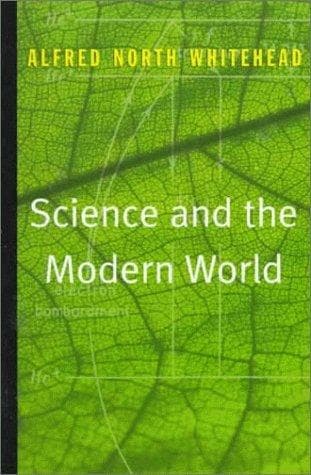
Science and the modern worldWhitehead, Alfred North
Religion
Science and the modern world
Whitehead, Alfred North
Science
But until the close of the Middle Ages the general educated public did
not feel that intimate conviction, and that detailed interest, in such
an idea, so as to lead to an unceasing supply of men, with ability and
opportunity adequate to maintain a coordinated search for the discovery
of these hypothetical principles. Either people were doubtful about the
existence of such principles, or were doubtful about any success in
finding them, or took no interest in thinking about them, or were
oblivious to their practical importance when found. For whatever reason,
search was languid, if we have regard to the opportunities of a high
civilisation and the length of time concerned. Why did the pace suddenly
quicken in the sixteenth and seventeenth centuries? At the close of the
Middle Ages a new mentality discloses itself. Invention stimulated
thought, thought quickened physical speculation, Greek manuscripts
disclosed what the ancients had discovered. Finally although in the year
1500 Europe knew less than Archimedes who died in the year 212 B. C.,
yet in the year 1700, Newton’s _Principia_ had been written and the
world was well started on the modern epoch.
There have been great civilisations in which the peculiar balance of
mind required for science has only fitfully appeared and has produced
the feeblest result. For example, the more we know of Chinese art, of
Chinese literature, and of the Chinese philosophy of life, the more we
admire the heights to which that civilization attained. For thousands of
years, there have been in China acute and learned men patiently devoting
their lives to study. Having regard to the span of time, and to the
population concerned, China forms the largest volume of civilisation
which the world has seen. There is no reason to doubt the intrinsic
capacity of individual Chinamen for the pursuit of science. And yet
Chinese science is practically negligible. There is no reason to believe
that China if left to itself would have ever produced any progress in
science. The same may be said of India. Furthermore, if the Persians had
enslaved the Greeks, there is no definite ground for belief that science
would have flourished in Europe. The Romans showed no particular
originality in that line. Even as it was, the Greeks, though they
founded the movement, did not sustain it with the concentrated interest
which modern Europe has shown. I am not alluding to the last few
generations of the European peoples on both sides of the ocean; I mean
the smaller Europe of the Reformation period, distracted as it was with
wars and religious disputes. Consider the world of the eastern
Mediterranean, from Sicily to western Asia, during the period of about
1400 years from the death of Archimedes [in 212 B. C.] to the irruption
of the Tartars. There were wars and revolutions and large changes of
religion: but nothing much worse than the wars of the sixteenth and
seventeenth centuries throughout Europe. There was a great and wealthy
Public-domain text, read in full here on John Shaqi.
Reviews
Reviews
No reviews yet
Be the first to share your thoughts on this work.
Join the Discussion
Join the discussion
Sign in to leave a comment or review.
Sign InorCreate an account