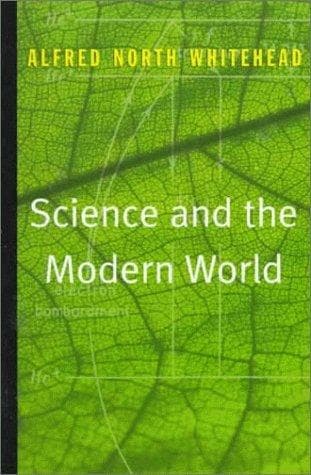
Science and the modern worldWhitehead, Alfred North
Religion
Science and the modern world
Whitehead, Alfred North
Science
“Ye Presences of Nature in the sky
And on the earth! Ye Visions of the hills!
And Souls of lonely places! can I think
A vulgar hope was yours when ye employed
Such ministry, when ye through many a year
Haunting me thus among my boyish sports,
On caves and trees, upon the woods and hills,
Impressed upon all forms the characters
Of danger or desire; and thus did make
The surface of the universal earth
With triumph and delight, with hope and fear,
Work like a sea?...”
In thus citing Wordsworth, the point which I wish to make is that we
forget how strained and paradoxical is the view of nature which modern
science imposes on our thoughts. Wordsworth, to the height of genius,
expresses the concrete facts of our apprehension, facts which are
distorted in the scientific analysis. Is it not possible that the
standardised concepts of science are only valid within narrow
limitations, perhaps too narrow for science itself?
Shelley’s attitude to science was at the opposite pole to that of
Wordsworth. He loved it, and is never tired of expressing in poetry the
thoughts which it suggests. It symbolises to him joy, and peace, and
illumination. What the hills were to the youth of Wordsworth, a chemical
laboratory was to Shelley. It is unfortunate that Shelley’s literary
critics have, in this respect, so little of Shelley in their own
mentality. They tend to treat as a casual oddity of Shelley’s nature
what was, in fact, part of the main structure of his mind, permeating
his poetry through and through. If Shelley had been born a hundred years
later, the twentieth century would have seen a Newton among chemists.
For the sake of estimating the value of Shelley’s evidence it is
important to realise this absorption of his mind in scientific ideas. It
can be illustrated by lyric after lyric. I will choose one poem only,
the fourth act of his _Prometheus Unbound_. The Earth and the Moon
converse together in the language of accurate science. Physical
experiments guide his imagery. For example, the Earth’s exclamation,
“The vaporous exultation not to be confined!”
is the poetic transcript of ‘the expansive force of gases,’ as it is
termed in books on science. Again, take the Earth’s stanza,
“I spin beneath my pyramid of night,
Which points into the heavens,—dreaming delight,
Murmuring victorious joy in my enchanted sleep;
As a youth lulled in love-dreams faintly sighing,
Under the shadow of his beauty lying,
Which round his rest a watch of light and warmth doth keep.”
Public-domain text, read in full here on John Shaqi.
Reviews
Reviews
No reviews yet
Be the first to share your thoughts on this work.
Elsewhere in the archive
Join the Discussion
Join the discussion
Sign in to leave a comment or review.
Sign InorCreate an account