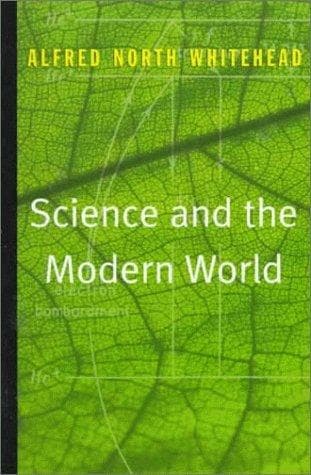
Science and the modern worldWhitehead, Alfred North
Religion
Science and the modern world
Whitehead, Alfred North
Science
If you try to imagine this doctrine in terms of our conventional views
of space and time, which presuppose simple location, it is a great
paradox. But if you think of it in terms of our naïve experience, it is
a mere transcript of the obvious facts. You are in a certain place
perceiving things. Your perception takes place where you are, and is
entirely dependent on how your body is functioning. But this functioning
of the body in one place, exhibits for your cognisance an aspect of the
distant environment, fading away into the general knowledge that there
are things beyond. If this cognisance conveys knowledge of a
transcendent world, it must be because the event which is the bodily
life unifies in itself aspects of the universe.
This is a doctrine extremely consonant with the vivid expression of
personal experience which we find in the nature-poetry of imaginative
writers such as Wordsworth or Shelley. The brooding, immediate presences
of things are an obsession to Wordsworth. What the theory does do is to
edge cognitive mentality away from being the necessary substratum of the
unity of experience. That unity is now placed in the unity of an event.
Accompanying this unity, there may or there may not be cognition.
At this point we come back to the great question which was posed before
us by our examination of the evidence afforded by the poetic insight of
Wordsworth and Shelley. This single question has expanded into a group
of questions. What are enduring things, as distinguished from the
eternal objects, such as colour and shape? How are they possible? What
is their status and meaning in the universe? It comes to this: What is
the status of the enduring stability of the order of nature? There is
the summary answer, which refers nature to some greater reality standing
behind it. This reality occurs in the history of thought under many
names, The Absolute, Brahma, The Order of Heaven, God. The delineation
of final metaphysical truth is no part of this lecture. My point is that
any summary conclusion jumping from our conviction of the existence of
such an order of nature to the easy assumption that there is an ultimate
reality which, in some unexplained way, is to be appealed to for the
removal of perplexity, constitutes the great refusal of rationality to
assert its rights. We have to search whether nature does not in its very
being show itself as self-explanatory. By this I mean, that the sheer
statement, of what things are, may contain elements explanatory of why
things are. Such elements may be expected to refer to depths beyond
anything which we can grasp with a clear apprehension. In a sense, all
explanation must end in an ultimate arbitrariness. My demand is, that
the ultimate arbitrariness of matter of fact from which our formulation
starts should disclose the same general principles of reality, which we
dimly discern as stretching away into regions beyond our explicit powers
of discernment.
Public-domain text, read in full here on John Shaqi.
Reviews
Reviews
No reviews yet
Be the first to share your thoughts on this work.
Elsewhere in the archive
Join the Discussion
Join the discussion
Sign in to leave a comment or review.
Sign InorCreate an account