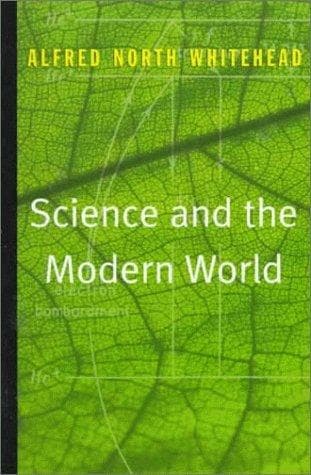
Science and the modern worldWhitehead, Alfred North
Religion
Science and the modern world
Whitehead, Alfred North
Science
In the period considered four great novel ideas were introduced into
theoretical science. Of course, it is possible to show good cause for
increasing my list far beyond the number _four_. But I am keeping to
ideas which, if taken in their broadest signification, are vital to
modern attempts at reconstructing the foundations of physical science.
Two of these ideas are antithetical, and I will consider them together.
We are not concerned with details, but with ultimate influences on
thought. One of the ideas is that of a field of physical activity
pervading all space, even where there is an apparent vacuum. This notion
had occurred to many people, under many forms. We remember the medieval
axiom, nature abhors a vacuum. Also, Descartes’ vortices at one time, in
the seventeenth century, seemed as if established among scientific
assumptions. Newton believed that gravitation was caused by something
happening in a medium. But, on the whole, in the eighteenth century
nothing was made of any of these ideas. The passage of light was
explained in Newton’s fashion by the flight of minute corpuscles, which
of course left room for a vacuum. Mathematical physicists were far too
busy deducing the consequences of the theory of gravitation to bother
much about the causes; nor did they know where to look, if they had
troubled themselves over the question. There were speculations, but
their importance was not great. Accordingly, when the nineteenth century
opened, the notion of physical occurrences pervading all space held no
effective place in science. It was revived from two sources. The
undulatory theory of light triumphed, thanks to Thomas Young and
Fresnel. This demands that there shall be something throughout space
which can undulate. Accordingly, the ether was produced, as a sort of
all pervading subtle material. Again the theory of electromagnetism
finally, in Clerk Maxwell’s hands, assumed a shape in which it demanded
that there should be electromagnetic occurrences throughout all space.
Maxwell’s complete theory was not shaped until the eighteen-seventies.
But it had been prepared for by many great men, Ampère, Oersted,
Faraday. In accordance with the current materialistic outlook, these
electromagnetic occurrences also required a material in which to happen.
So again the ether was requisitioned. Then Maxwell, as the immediate
first-fruits of his theory, demonstrated that the waves of light were
merely waves of his electromagnetic occurrences. Accordingly, the theory
of electromagnetism swallowed up the theory of light. It was a great
simplification, and no one doubts its truth. But it had one unfortunate
effect so far as materialism was concerned. For, whereas quite a simple
sort of elastic ether sufficed for light when taken by itself, the
electromagnetic ether has to be endowed with just those properties
necessary for the production of the electromagnetic occurrences. In
fact, it becomes a mere name for the material which is postulated to
Public-domain text, read in full here on John Shaqi.
Reviews
Reviews
No reviews yet
Be the first to share your thoughts on this work.
Elsewhere in the archive
Join the Discussion
Join the discussion
Sign in to leave a comment or review.
Sign InorCreate an account