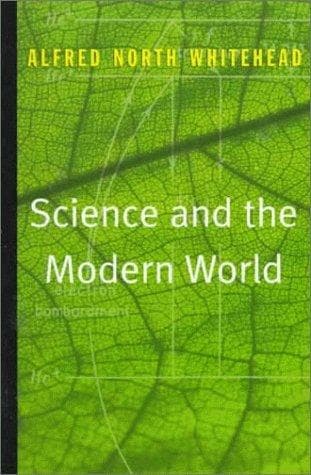
Science and the modern worldWhitehead, Alfred North
Religion
Science and the modern world
Whitehead, Alfred North
Science
underlie these occurrences. If you do not happen to hold the
metaphysical theory which makes you postulate such an ether, you can
discard it. For it has no independent vitality.
Thus in the seventies of the last century, some main physical sciences
were established on a basis which presupposed the idea of _continuity_.
On the other hand, the idea of _atomicity_ had been introduced by John
Dalton, to complete Lavoisier’s work on the foundation of chemistry.
This is the second great notion. Ordinary matter was conceived as
atomic: electromagnetic effects were conceived as arising from a
continuous field.
There was no contradiction. In the first place, the notions are
antithetical; but, apart from special embodiments, are not logically
contradictory. Secondly, they were applied to different regions of
science, one to chemistry, and the other to electromagnetism. And, as
yet, there were but faint signs of coalescence between the two.
The notion of matter as atomic has a long history. Democritus and
Lucretius will at once occur to your minds. In speaking of these ideas
as novel, I merely mean _relatively novel_, having regard to the
settlement of ideas which formed the efficient basis of science
throughout the eighteenth century. In considering the history of
thought, it is necessary to distinguish the real stream, determining a
period, from ineffectual thoughts casually entertained. In the
eighteenth century every well-educated man read Lucretius, and
entertained ideas about atoms. But John Dalton made them efficient in
the stream of science; and in this function of efficiency atomicity was
a new idea.
Public-domain text, read in full here on John Shaqi.
Reviews
Reviews
No reviews yet
Be the first to share your thoughts on this work.
Elsewhere in the archive
Join the Discussion
Join the discussion
Sign in to leave a comment or review.
Sign InorCreate an account