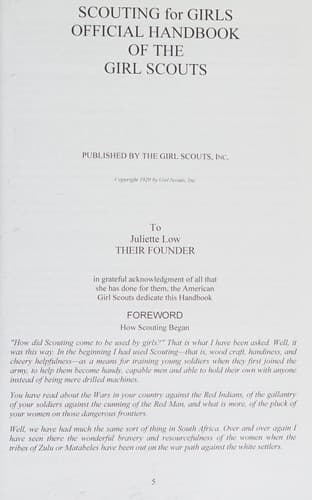
Scouting For Girls, Official Handbook of the Girl ScoutsGirl Scouts of the United States of America
History
Scouting For Girls, Official Handbook of the Girl Scouts
Girl Scouts of the United States of America
Girl Scouts -- Handbooks, manuals, etc.
The pulse may be counted on the thumb side of the inside of the wrist,
at the temples, the ankles, and other parts of the body where the
arteries are near the surface.
The pulse shows the number of times per minute which the heart beats or
pumps.
A normal pulse rate for a man is around 72, for a woman 80, for a child
90, and for a baby 100 beats.
A very rapid or a very slow pulse shows that there is something wrong
that should be reported. It takes a good deal of practice to learn to
count the pulse.
Place two or three fingers on the beating artery, just touching firmly
enough to feel the beats, and count for a half minute, then multiply by
two to find the number of beats per minute. Be sure that the patient's
hand is in a comfortable position while counting.
Respiration
Respiration is another word for breathing. An average normal person when
sitting or lying still, breathes from twelve to twenty times per minute,
and when moving about 24 times. We all know that quick moving makes
quick breathing.
Respiration above 40 or below 8 is a danger sign. If the respiration is
very fast, or difficult, or wheezy, or in any way very unusual, we can
tell it at a glance. People who are breathing hard are frequently
relieved by being propped up in bed.
_To count the respiration._ It is better to do this without the person's
knowledge. It may be counted by watching the rise and fall of the chest
or of the shoulders. Another way is to hold the person's hand as though
taking the pulse, having her rest her hand and forearm lightly on the
chest and count the rise and fall.
Dishes
Dishes used by patients with any of the contagious diseases, and this
includes colds and sore throats, should be kept separate, and washed
separately from the family dishes. They should be scalded after washing
and have special dish cloths. Using separate utensils, and a separate
room for the sick person are two of the surest ways to prevent the
spread of the disease.
In such diseases as measles, scarlet fever, colds, mumps, influenza,
dishes should be boiled every day. Put them in a large kettle in cold
water and let them come to a boil. Even the thinnest glass will not
break if treated in this way. Let the dishes stay in the water until
cool enough to handle.
Dish cloths and dish mops should be thoroughly washed in good hot water
and soap, and put in the sun to dry. They should be boiled regularly.
If it is necessary to disinfect linen put it all in a bag and leave in
cold water to soak for some hours before putting it on to boil. Put a
little washing soda in the water. After boiling hard for fifteen or
twenty minutes it may be washed with the other garments.
Stains should be washed out before putting linen in the wash.
Utensils and Their Care
Public-domain text, read in full here on John Shaqi.
Reviews
Reviews
No reviews yet
Be the first to share your thoughts on this work.
Elsewhere in the archive
Join the Discussion
Join the discussion
Sign in to leave a comment or review.
Sign InorCreate an account