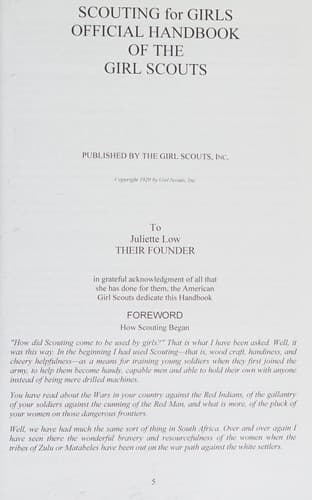
Scouting For Girls, Official Handbook of the Girl ScoutsGirl Scouts of the United States of America
History
Scouting For Girls, Official Handbook of the Girl Scouts
Girl Scouts of the United States of America
Girl Scouts -- Handbooks, manuals, etc.
_All utensils should be kept clean and ready for instant use._ The
bedpan should always be warmed before being used. Running warm water in
and on it is usually the easiest way to do this. It should be thoroughly
dried on the outside so that it will not wet the bed. It is a good plan
to have a piece of rubber sheet or several thicknesses of old newspapers
covered with a bath towel to put under the bedpan in bed. When carrying
away, keep covered. Use cold water first, and after washing with soapy
water, rinse and dry before putting away.
Basins in constant use, especially if they are used to hold
disinfectant, need to be well scoured with sapolio from time to time.
Nothing is more shiftless looking than a dark rim of dirt or stain
around a basin.
Hot water bags should be emptied when not in use and hung upside down.
The stoppers should be kept fastened to them.
Ice caps should be dried inside and out and stuffed with cotton or
tissue paper to keep the sides from sticking together.
Hot and Cold Applications
Hot applications are used to relieve pain, to supply heat, and to bring
down temperature. Both moist and dry heat are used. Hot water bags,
metal heaters, electric pads, hot flannels are the commonest forms of
dry heat. Fomentations, poultices, and baths are the simplest forms of
moist heat.
In applying heat, one should be ever on the watch to avoid burning a
patient. The skin of babies, children, old people, and of those who have
been ill a long time, is very easily burned. Again, the same heat that
is easily tolerated by one person, may burn another.
_Hot water bags_ or their substitute, electric pads or metal heaters
should always be wrapped in towels or have their own coverings. Never
fill a hot water bag more than two-thirds full. The water should not be
hot enough to scald a patient if the bag should spring a leak. Before
putting in the cork, expel the air by twisting the upper part between
the neck and the level of the water before putting in the cork. Be sure
to cork tightly. If the bag is to be where the patient will bear the
weight, put in a very little water and renew from time to time. Where
there is no hot water bag, stone bottles may be used, or bags of salt or
sand may be heated in the oven. The practice of using ordinary glass
bottles is an unsafe one, as the corks are not always to be depended on
to stay tight and the glass breaks easily. When bags of salt or sand are
used the coverings should be thick enough to prevent the particles from
sifting through. Pieces of flannel the right size may in some cases
supply all the heat that is necessary. They should be covered with
another flannel to keep in the warmth.
Public-domain text, read in full here on John Shaqi.
Reviews
Reviews
No reviews yet
Be the first to share your thoughts on this work.
Elsewhere in the archive
Join the Discussion
Join the discussion
Sign in to leave a comment or review.
Sign InorCreate an account