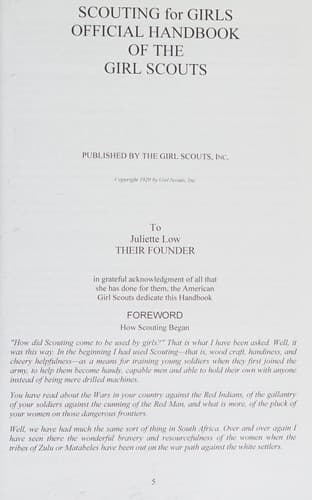
Scouting For Girls, Official Handbook of the Girl ScoutsGirl Scouts of the United States of America
History
Scouting For Girls, Official Handbook of the Girl Scouts
Girl Scouts of the United States of America
Girl Scouts -- Handbooks, manuals, etc.
In order to ensure protection from the rain spread one waterproof
covering or poncho on the ground using half underneath so that the upper
half may be folded over the head in case of rain. Put blankets _under_
as well as _over_ you, and a second waterproof covering over the
blankets.
Clothing
When living out of doors, one may make shift for shelter, or even go
hungry for a space, but there is no substitute for comfortable clothing
that is safe to use if one would keep well. Horace Kephart, the master
camper, devotes much space to this subject, and we can do no better than
to follow his advice from Camping and Woodcraft.
"* * * One soon learns that the difference between comfort and misery,
if not health and illness, may depend on whether he is properly clad.
Proper, in this case does not mean modish, but suitable, serviceable,
proven by the touchstone of experience to be best for the work or play
that is in hand. When you seek a guide in the mountains, he looks first
in your eyes and then at your shoes. If both are right, you are right.
"The chief uses of clothing are to help the body maintain its normal
temperature and to protect it from sun, frost, wind, rain and injuries.
_To help_, mind you--the body must be allowed to do its share.
"Perspiration is the heat-regulating mechanism of the body. Clothing
should hinder its passage from the skin as little as possible. For this
reason one's garments should be _permeable_ to air. The body is cooled
by rapid evaporation, on the familiar principle of a tropical water bag
that is porous enough to let some of the water exude. So the best summer
clothing is that which permits free evaporation--and this means all
over, from head to heel. In winter it is just the same, there should be
free passage for bodily moisture through the underclothes, but extra
layers or thickness of outer clothing are needed to hold in the bodily
heat and to protect one against wind; even so all the garments should be
permeable to air. * * *"
"Underclothing, for any season, should be loosely woven, so as to hold
air and take up moisture from the body. The air confined in the
interspaces is a non-conductor, and so helps to prevent sudden chilling
on the one hand, and over-heating on the other. A loose texture absorbs
perspiration but does not hold it--the moisture is free to pass on to
and through the outer garments. In town we may indure close woven
underwear in summer, if thin enough, because we exercise little and can
bathe and change frequently. In the woods we would have to change four
times a day to keep * * * as dry.
"_Wool versus Cotton_--Permeability also depends upon material. Ordinary
cotton and linen goods do not permit rapid evaporation. They absorb
moisture from the skin, but hold it up to the limit of saturation. Then,
when they can hold no more, they are clammy, and the sweat can only
escape by running down one's skin.
Public-domain text, read in full here on John Shaqi.
Reviews
Reviews
No reviews yet
Be the first to share your thoughts on this work.
Elsewhere in the archive
Join the Discussion
Join the discussion
Sign in to leave a comment or review.
Sign InorCreate an account