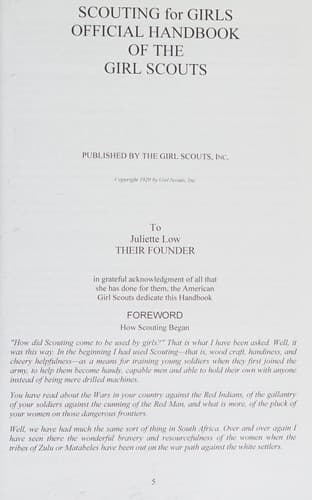
Scouting For Girls, Official Handbook of the Girl ScoutsGirl Scouts of the United States of America
History
Scouting For Girls, Official Handbook of the Girl Scouts
Girl Scouts of the United States of America
Girl Scouts -- Handbooks, manuals, etc.
Shoes should be the shape of the feet and have low, wide heels. It rests
the feet to take the shoes off once or twice during a long tramp.
Grease the shoes every few days with mutton fat or other grease. There
is no such thing as waterproof leather, but it can be made so by being
greased. After being wet, shoes should be well dried and greased, but
should not be dried in a hot place, for this would ruin the leather.
These may seem trifling details, but remember, "no army is stronger than
its feet."
Things to Remember
Keep the feet straight when walking. If a Girl Scout notices the tracks
of an Indian, the first hikers in this country, she will find them
invariably straight forward. Scientists have agreed that the dancing
school habit of turning out toes is one of the causes of flat feet,
which disqualified so many men for army service.
Start the walk slowly. Keep the pace of the slowest of the party. "Slow
and easy goes far in a day." Practice deep breathing. Inhale for five
steps, hold your breath for five counts, and let it out, again counting
five.
Take short steps when climbing. Do not run down hill. It causes
stiffness, for which a hot bath and another walk the next day are the
best cure.
When lunch is carried it should be divided among the troop. Each Scout
should carry her knapsack on her back, to leave the hands free. It is a
great mistake to start on a hike with one's arms laden.
Do not plan to go too great a distance in the time at your disposal.
Remember that aside from the time you need for going and coming you
expect to enjoy yourselves cooking and eating, and you need time for
both. For an over-night hike, when you carry your equipment select a
spot not more than two miles distant.
Good things to carry in one's pocket are a drinking cup, a geological
survey map (ten cents), a small pocket compass, a camper's knife, a
small soapstone to sharpen it, a match box, and a note-book and pencil.
Plan a definite object for the hike. Note how many kinds of trees, wild
flowers or birds one can find.
Practice building fires for cooking, or getting material for a bed such
as balsam, etc. Inquire for points of historical interest and make them
the goal of the hike. There is hardly a town that has not some place
connected with the early history of the nation.
Personal Equipment
Spending the nights under the stars is one of the great fascinations of
camping. Each person requires two waterproof ground cloths or ponchos,
two pairs of light wool blankets, safety pins, heavy cord, sleeping
garments, rain coat, and toilet articles, including such things as soap,
toilet paper, sewing kit, electric flashlight, mirror, first aid kit,
provision for mosquitoes or flies, five yards of bar netting, and oil of
citronella.
Public-domain text, read in full here on John Shaqi.
Reviews
Reviews
No reviews yet
Be the first to share your thoughts on this work.
Elsewhere in the archive
Join the Discussion
Join the discussion
Sign in to leave a comment or review.
Sign InorCreate an account