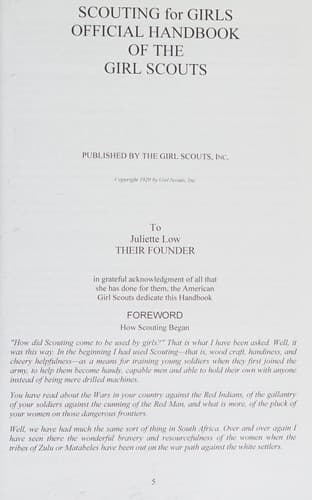
Scouting For Girls, Official Handbook of the Girl ScoutsGirl Scouts of the United States of America
History
Scouting For Girls, Official Handbook of the Girl Scouts
Girl Scouts of the United States of America
Girl Scouts -- Handbooks, manuals, etc.
"The arts of fire building are not so simple as they look. To practice
them successfully in all sorts of wild regions we must know the
different species of trees one from another, and their relative fuel
values, which as we shall see, vary a great deal. We must know how well,
or ill, each of them burns in a green state, as well as when seasoned.
It is important to discriminate between wood that makes lasting coals
and such as soon dies down to ashes. Some kinds of wood pop violently
when burning and cast out embers that may burn holes in tents and
bedding or set the neighborhood afire; others burn quietly, with clear,
steady flame. Some are stubborn to split, others almost fall apart under
the axe. In wet weather it takes a practiced woodsman to find tinder and
dry wood, and to select a natural shelter where fire can be kept going
during a storm or rain or snow, when a fire is most needed.
"There are several handy little manuals by which one who has no
botanical knowledge can soon learn how to identify the different species
of trees by merely examining their leaves, or, late in the season, by
their bark, buds and habit of growth.
"But no book gives the other information that I have referred to; so I
shall offer, in the present chapter, a little rudimentary instruction in
this important branch of woodcraft.
"It is convenient for our purpose to divide the trees into two great
groups, hard woods and soft woods, using these terms not so loosely as
lumbermen do, but drawing the line between sycamore, yellow birch,
yellow pine, and slippery elm, on the one side, and red cedar,
sassafras, pitch pine and white birch, on the other.
"_As a general rule_, hard woods make good, slow-burning fuel that
yields lasting coals, and soft woods make a quick, hot fire that is soon
spent. But each species has peculiarities that deserve close attention.
"_Best Fuel_--Best of all northern fire woods is hickory, green or dry.
It makes a hot fire, but lasts a long time, burning down to a bed of
hard coals that keep up an even, generous heat for hours. Hickory, by
the way, is distinctly an American tree; no other region on earth
produces it. The live oak of the south is most excellent fuel; so is
holly. Following the hickory, in fuel value, are chestnut, oak, overcup,
white, blackjack, post and basket oaks, pecan, the hornbeams
(ironwoods), and dogwood. The latter burns finely to a beautiful white
ash that is characteristic; apple wood does the same. Black birch also
ranks here; it has the advantage of 'doing its own blowing,' as a
Carolina mountaineer said to me, meaning that the oil in the birch
assists its combustion so that the wood needs no coaxing. All of the
birches are good fuel, ranking in about this order: Black, yellow, red,
paper, and white. Sugar maple was the favorite fuel of our old-time
hunters and surveyors because it ignites easily, burns with a clear,
steady flame, and leaves good coals.
Public-domain text, read in full here on John Shaqi.
Reviews
Reviews
No reviews yet
Be the first to share your thoughts on this work.
Elsewhere in the archive
Join the Discussion
Join the discussion
Sign in to leave a comment or review.
Sign InorCreate an account