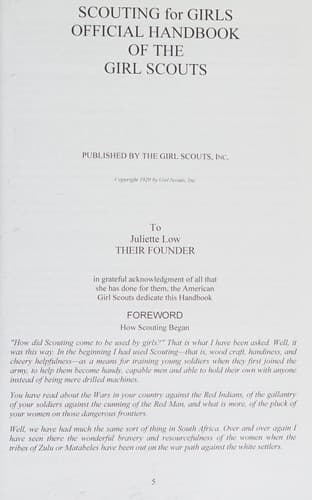
Scouting For Girls, Official Handbook of the Girl ScoutsGirl Scouts of the United States of America
History
Scouting For Girls, Official Handbook of the Girl Scouts
Girl Scouts of the United States of America
Girl Scouts -- Handbooks, manuals, etc.
"Locust is a good, lasting fuel; it is easy to cut, and, when green,
splits fairly well; the thick bark takes fire readily and the wood then
burns slowly, with little flame, leaving pretty good coals; hence it is
good for night wood. Mulberry has similar qualities. The scarlet and
willow oaks are among the poorest of the hard woods for fuel. Cherry
makes only fair fuel. White elm is poor stuff, but slippery elm is
better. Yellow pine burns well, as its sap is resinous instead of watery
like that of the soft pines.
"In some respects white ash is the best of green woods for campers fuel.
It is easily cut and split, is lighter to tote than most other woods,
and is of so dry a nature that even the green wood catches fire readily.
It burns with clear flame, and lasts longer than any other free-burning
wood of its weight. On a wager, I have built a bully fire from a green
tree of white ash, one match, and no dry kindling. I split some of the
wood very fine and 'frilled' a few of the little sticks with my knife.
"_Soft Woods_--Most of the soft woods are good only for kindling, or for
quick cooking fires, and then only when seasoned. For these purposes,
however, some of them are superior, as they split and shave readily and
catch fire easily.
"Liquidambar, magnolia, tulip, catalpa, and willow are poor fuel.
Seasoned chestnut and yellow poplar make a hot fire, but crackle and
leave no coals. Balsam fir, basswood, and the white and loblolly pines
make quick fires, but are soon spent. The grey (Labrador) or jack pine
is considered good fuel in the far north, where hard woods are scarce.
Seasoned tamarack is good. Spruce is poor fuel, although, being
resinous, it kindles easily and makes a good blaze for 'branding up' a
fire. Pitch pine, which is the most inflammable of all woods when dry
and 'fat,' will scarcely burn at all in a green state. Sycamore and
buckeye, when thoroughly seasoned, are good fuel, but will not split.
Alder burns readily and gives out considerable heat, but is not lasting.
"The dry wood of the northern poplar (large-toothed aspen) is a favorite
for cooking fires, because it gives an intense heat, with little or no
smoke, lasts well, and does not blacken the utensils. Red cedar has
similar qualities, but is rather hard to ignite and must be fed fine at
the start.
"The best green soft woods for fuel are white birch, paper birch, soft
maple, cottonwood, and quaking aspen.
"As a rule, the timber growing along the margins of large streams is
softwood. Hence, driftwood is generally a poor mainstay unless there is
plenty of it on the spot; but driftwood on the sea coast is good fuel.
Public-domain text, read in full here on John Shaqi.
Reviews
Reviews
No reviews yet
Be the first to share your thoughts on this work.
Elsewhere in the archive
Join the Discussion
Join the discussion
Sign in to leave a comment or review.
Sign InorCreate an account