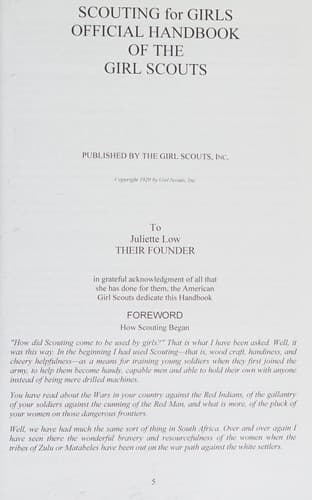
Scouting For Girls, Official Handbook of the Girl ScoutsGirl Scouts of the United States of America
History
Scouting For Girls, Official Handbook of the Girl Scouts
Girl Scouts of the United States of America
Girl Scouts -- Handbooks, manuals, etc.
Bend it around the rope in the right hand;
Pull tight.
2. Sheet-bend
Another knot that is used for tying two ends together, generally those
of unequal thickness, or for fastening an end to a permanent loop, is
the Sheet-bend.
[Illustration: 2a. Sheet Bend: Loose]
[Illustration: 2b. Sheet Bend: Drawn Tight]
To make a Sheet-bend:
Make in the end of the larger rope a small bight or use the permanent
loop in its place;
Pass the end of the smaller rope up through the bight;
Under the bight;
Over the bight;
Under its own standing part;
Pull the loops tight.
This is the way the Girl Scout tied the rope together for the stage
hands.
3. Bowline-Knot
If the people on the bridge at Niagara Falls had made a Bowline-knot in
the end of the rope before throwing it as a life-line they might have
saved one if not three lives. A Bowline is used chiefly for hoisting and
lowering; it can be used for a halter or with the Sheet-bend in making a
guard-line or fence. It is a knot holding fast a loop which can be made
of any size and which will not jam or give.
To make a Bowline-knot:
Take the end in the right hand;
Draw the rope toward you over the palm of the left hand, measuring off
as much as is needed to make the required size loop;
Drop the end;
Make a small bight in the palm of the left hand by turning the rope
toward the ends of the fingers;
Take the end in the right hand;
Pass it up through the bight;
Back of and around the standing part;
Down through the bight;
Pull the end and the rope forming the loop against the standing part.
When the Bowline is used for hoisting or lowering a person as in case of
fire, the loop should be large enough to be used as a seat; it should be
passed over the head and shoulders, the standing part in front of the
body, to be held on to with both hands.
When using a rope for a life-line:
Fasten securely one end to something that will not give.
Make a Bowline at the other end of the line large enough to go over the
head and shoulders;
Hold the knot in the right hand, the end toward you;
Take the standing part in the left hand, measure off about three feet of
rope;
Draw the rope toward you, pass it over the palm of the right hand and
hold fast.
Again measure off the same amount, draw the rope toward you, pass it
over the palm of the right hand, and hold fast;
Continue this process until enough rope is coiled to more than cover the
distance to the person in the water.
Grasp the coil firmly in the right hand;
Hold the standing part in the left hand;
Draw the right arm back from the shoulder;
[Illustration: 3. Bowline]
Swing the arm forward and throw the coil out over the water to the
person in distress;
Make sure that the person in the water gets a firm grasp on the rope;
Quickly take the standing part in both hands;
Pull on the rope with a hand over hand motion, keep the line taut and
pull the person to safety.
Public-domain text, read in full here on John Shaqi.
Reviews
Reviews
No reviews yet
Be the first to share your thoughts on this work.
Elsewhere in the archive
Join the Discussion
Join the discussion
Sign in to leave a comment or review.
Sign InorCreate an account