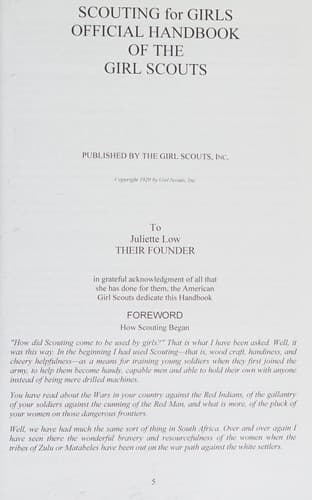
Scouting For Girls, Official Handbook of the Girl ScoutsGirl Scouts of the United States of America
History
Scouting For Girls, Official Handbook of the Girl Scouts
Girl Scouts of the United States of America
Girl Scouts -- Handbooks, manuals, etc.
Do not make the mistake of throwing the coil "up"; throw it _out_ over
the water.
The important points to remember when using a rope for rescue work are
to fasten the free end so the rope will not slip out of reach; to coil
the rope properly so it will not kink or knot when let out; and to make
a Bowline large enough to go around the body.
When a group of Scouts make a guard line, each girl makes a Bowline in
the end of her rope, large enough to put her hand through, fasten her
right-hand neighbor's rope to it by means of a Sheet-bend and holds her
portion of the line in place by using the Bowline in her rope for a
handle.
[Illustration: 4. Two Half-Hitches]
Two Half-hitches are used to make fast an end of rope to a pole, post,
etc. It is a knot that can be easily undone. It is used for hauling,
fastening awning ropes, flag ropes, etc.
To make a Half-hitch:
Take the end in the right hand;
Pass the end under and around the pole;
Around the standing part:
Under itself, forming a bight out of which the standing part comes.
Repeat this for the second half-hitch, using standing part in place of
pole.
[Illustration: 5. Clove-Hitch]
The purpose of a Clove-hitch, which is also called the Builders' Knot,
is to make fast an end of rope, generally to a post or tree. This knot
holds securely and does not slip laterally. It is of value when
tethering an animal or tying a boat. It can be used for fastening an
awning rope, tent ropes, for tying on splints or fastening the end of a
bandage when it is used to confine a delirious person.
A fence or guard-line can be made where trees or posts are available by
tying the end of the rope by means of a Half-hitch to the first tree,
and then using a Clove-hitch on the other trees or posts.
To tie the Clove-hitch:
Take the end in the right hand;
Pass it around the post;
Over the standing part;
Continue around the post;
Under the standing part;
Slip the end up through the lower loop;
Pull tight.
[Illustration: 6. Sheep-Shank]
The purpose of a Sheep-shank is to take up slack or shorten a rope
temporarily. It is used on tent ropes, tow lines.
To make the Sheep-shank:
Cross the hands and take hold of the rope;
Take up the slack by drawing the hands past each other;
Hold the two long loops firmly in one hand;
Make a bight in the rope between the loop and the end;
Pass the loop through the bight;
Do the same thing at the other end.
The knot will stay in place so long as the rope is taut.
If it is necessary to shorten a rope when neither end is held fast, make
the Sheep-shank and pass each end through the bight nearest to it.
[Illustration: Ready For Transportation or Storage]
When in uniform a Girl Scout hangs her rope on a belt-hook placed in her
belt or skirt-binding.
_To have the rope in a convenient form:_
Make two loops five or six inches long at one end of the rope;
Public-domain text, read in full here on John Shaqi.
Reviews
Reviews
No reviews yet
Be the first to share your thoughts on this work.
Elsewhere in the archive
Join the Discussion
Join the discussion
Sign in to leave a comment or review.
Sign InorCreate an account