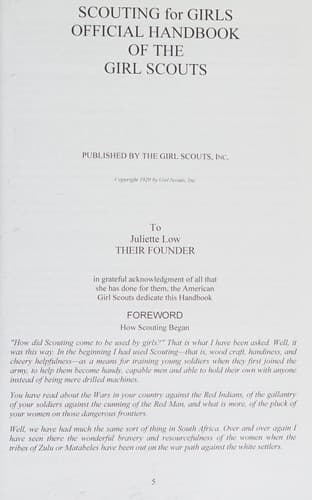
Scouting For Girls, Official Handbook of the Girl ScoutsGirl Scouts of the United States of America
History
Scouting For Girls, Official Handbook of the Girl Scouts
Girl Scouts of the United States of America
Girl Scouts -- Handbooks, manuals, etc.
"Recollections of a Drummer Boy," H. M. Kieffer, Houghton Mifflin
[Illustration: ECONOMIST
SYMBOL--BEE]
A Girl Scout must qualify for 1 and 2, and either 3 or 4.
1. Offer record of ten per cent. savings from
earnings or allowance for three months.
Show card for Postal Savings, or a Savings Bank
Account.
2. Show record from parent or guardian that she
has:
a. Darned stockings.
b. Keep shoes shined and repaired.
c. Not used safety pins or other makeshift for
buttons, hooks, hems of skirts, belts, etc.
d. Kept clothes mended and cleansed from small
spots.
3. For girls who have the spending of their money,
either in allowance or earnings, show by character
of shoes, stockings and gloves, hair-ribbons,
handkerchiefs and other accessories that they know
how to select them for wearing qualities and how
to keep them in repair.
4. Show record of one week's buying and menus with
plans for using food economically, such as
left-overs, cheap but nourishing cuts of meat,
butter substitutes, thrifty use of milk such as
sour, skimmed or powdered milk, and so forth.
REFERENCES:
"Scout Law in Practice," A. A. Carey, Little.
"Thrift and Conservation," A. H. Chamberlain, Lippincott.
[Illustration: ELECTRICIAN
SYMBOL--LIGHTNING]
1. Explain the use of magnets for attraction and
repulsion.
2. Describe the use of electricity for forming
electro-magnets and their use in: Electric bell;
Telegraph; Telephone.
3. What is meant by low and high voltage in
electric current? Describe the use of current in:
Dry cell; Storage Battery; Dynamo.
4. a. Describe how current is sent through
resistance wire resulting in heat and light, in
case of Electric lights, Electric stoves,
toasters, flat irons, etc., and
b. How it is converted into working energy in
Motors.
5. Describe fuses and their use, and how to
replace a burnt-out fuse.
6. Connect two batteries in series with a bell and
push button.
7. Demonstrate methods of rescuing a person in
contact with live wires, and of resuscitating a
person insensible from shock.
8. Know how electricity is used as motive power
for street cars, trains, and automobiles.
9. Know the proper way to connect electric
appliances such as flat irons, toasters, etc.
REFERENCES:
"Electricity in Every Day Use," J. F. Woodfull, Doubleday Page.
"How to Understand Electrical Work," W. H. Onken, Harper.
"Harper's Electricity Book for Boys," J. H. Adams, Harper.
"Electricity for Young People," Tudor Jenks, Stokes.
Public-domain text, read in full here on John Shaqi.
Reviews
Reviews
No reviews yet
Be the first to share your thoughts on this work.
Elsewhere in the archive
Join the Discussion
Join the discussion
Sign in to leave a comment or review.
Sign InorCreate an account