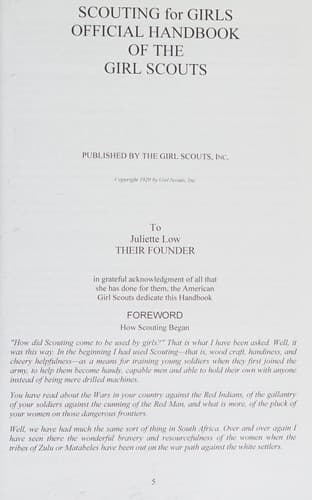
Scouting For Girls, Official Handbook of the Girl ScoutsGirl Scouts of the United States of America
History
Scouting For Girls, Official Handbook of the Girl Scouts
Girl Scouts of the United States of America
Girl Scouts -- Handbooks, manuals, etc.
"Heroes of Progress in America," Charles Morris, Lippincott.
[Illustration: FARMER
SYMBOL--SICKLE]
This badge is given for proficiency in general farming. A Scout farmer
may have her chief interest in rearing animals but she should know
something about the main business of the farmer which is tilling the
soil. Therefore, the Scout must fulfill four requirements: either A or B
under I, and II, III, and IV.
I. A. Animal Care
A Scout must have reared successfully one of the following:
a) A brood of at least 12 chickens under hen or
with incubator.
b) A flock of at least 12 pigeons, 12 ducks, 12
geese or 12 guinea-fowl.
c) A family of rabbits or guinea pigs.
d) A calf, a colt, or a pig.
A certificate as to the condition of the animals must be presented, made
by some competent judge who has seen them. Wherever possible a chart
should be made by the Scout, showing the schedule of care followed,
including feeding, and notes on the development of the animals.
AND she must also have planted and cultivated a small vegetable garden
like the one described in the Handbook, in the Section "The Girl Scout's
Own Garden" OR
B. Vegetable raising
A Scout may make her main interest the raising of some sort of vegetable
or fruit and may do one of the following:
1. Plant, cultivate and gather the crop from
(a) A small truck garden, with at least six
vegetables, two berries, and two salads or greens,
OR
(b) Where the soil is not suitable for a variety
of plants, she may raise a single vegetable, like
corn or tomatoes, or tubers.
2. Tend and gather a fruit crop such as apples,
peaches, pears, cherries, oranges, or any other
tree fruit, OR Cultivate and tend a small vineyard
or grape arbor, and gather the grapes, OR
Plant and cultivate and gather the berries from
strawberry, raspberry, blackberry, currant or
gooseberry plants. Whatever the vegetable or fruit
chosen a chart should be made and presented,
showing the schedule of digging, planting, sowing
and tending, with notes on the time of appearance
of the first shoots, the size and condition of the
crop and so forth. Any obstacles met and overcome,
such as insect pests, drouths or storms should be
mentioned. No special size is mentioned for the
garden, as the conditions vary so greatly in
different parts of the country. The quality of the
work, and the knowledge gained is the important
thing.
II. Identify and collect ten common weeds and tell how to get rid of
each.
III. Identify ten common insect pests, tell what plant or animal each
attacks, and how to get rid of each.
Public-domain text, read in full here on John Shaqi.
Reviews
Reviews
No reviews yet
Be the first to share your thoughts on this work.
Elsewhere in the archive
Join the Discussion
Join the discussion
Sign in to leave a comment or review.
Sign InorCreate an account