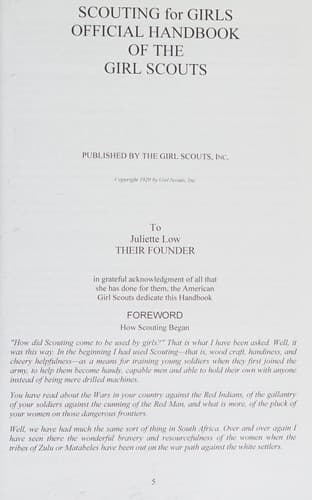
Scouting For Girls, Official Handbook of the Girl ScoutsGirl Scouts of the United States of America
History
Scouting For Girls, Official Handbook of the Girl Scouts
Girl Scouts of the United States of America
Girl Scouts -- Handbooks, manuals, etc.
2. What are the laws concerning the public
collection and disposal of garbage? How much
responsibility in this line has your family? Can
you do what you please? Is there any practical use
for garbage?
3. What is the source of your local water supply?
What measures are taken to make and keep it
pure?--State some of the results of lack of care
in this matter.
4. Why should there be regulations about spitting
in public places? Why are common towels and
drinking cups forbidden? What are the general
rules for prevention and treatment of
tuberculosis?
5. Trace the life history of the house fly or
filth fly and tell why it is a menace. How may the
fly be exterminated? How are mosquitoes dangerous?
How may they be eliminated?
REFERENCES:
"Democracy in Reconstruction," Frederick A. Cleveland and Joseph
Schafer, Houghton Mifflin.
"A Manual for Health Officers," J. Scott MacNutt, John Wiley and Sons.
"House of the Good Neighbor," Esther Lovejoy, Macmillan.
"Community Civics," J. Field, Macmillan.
"Town and City," F. G. Jewett, Ginn and Co.
"Good Citizenship," J. Richman, American Book Co.
"Healthy Living," Charles E. Winslow, Merrill Co.
[Illustration: HEALTH WINNER
SYMBOL--THE CADUCEUS IN TREFOIL]
I. To earn this badge a Girl Scout must for three
months pay attention to those conditions upon
which health depends. She should keep a Health
Record like that shown in the Handbook, which must
cover at least the following points:
1. Position of body: Show improvement in posture.
2. Exercise (a) Walk a mile briskly or walk
steadily and vigorously for fifteen minutes, or
take some other active and vigorous outdoor
exercise for at least thirty minutes. OR in case
of bad weather, (b) Do setting-up exercises as
given in Handbook every day. At least twenty
minutes should be spent on these, either at one
time, or ten minutes night and morning. To make
this point will require a record of compliance for
at least seventy-five days in three months.
3. Rest. (a) Go to bed early. Be in bed by at
least 9:30 and sleep from eight to ten hours. Do
not go to parties, the theatre, movies or any
other late entertainment on nights before school
or work.
4. Supply needs for Air, Water and Food in the
right way:
(a) Sleep with window open.
(b) Drink at least six glasses of water during the
day, between meals; taking one before breakfast,
two between breakfast and lunch, two between lunch
and dinner, and one before going to bed.
Public-domain text, read in full here on John Shaqi.
Reviews
Reviews
No reviews yet
Be the first to share your thoughts on this work.
Elsewhere in the archive
Join the Discussion
Join the discussion
Sign in to leave a comment or review.
Sign InorCreate an account