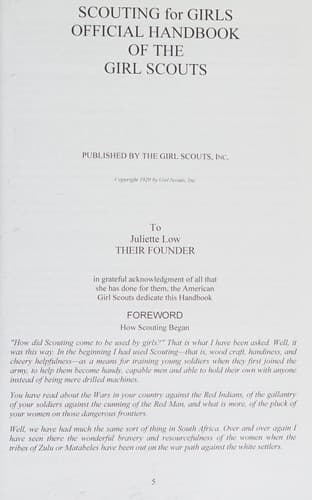
Scouting For Girls, Official Handbook of the Girl ScoutsGirl Scouts of the United States of America
History
Scouting For Girls, Official Handbook of the Girl Scouts
Girl Scouts of the United States of America
Girl Scouts -- Handbooks, manuals, etc.
8. Know how to mark a trail.
9. Tell what to do to make water safe for drinking
if there is any question as to its purity.
REFERENCES:
"Campward Ho!" A Manual for Girl Scout Camps, National Headquarters,
Girl Scouts, Inc.
"Camping and Woodcraft," Horace Kephart, Macmillan.
"On the Trail," L. Beard, Scribner.
"Vacation Camps for Girls," Jeannette Marks, D. Appleton.
[Illustration: ROCK TAPPER[9]
SYMBOL--PICK AND SHOVEL]
1. Collect and correctly identify ten rocks found
among the glacial boulders.
2. Make photograph or make sketch of glacial
boulders.
3. Collect two or three scratched glaciated
pebbles or cobblestones in the drift.
4. Make a sketch or photograph of an exposed
section of glaciated or scratched bed-rock and
note as accurately as you can the direction of the
scratches or grooves.
REFERENCES:
"The Story of Our Continent," N. S. Shaler, Ginn and Co.
"The Great Ice Age and Its Relation to the Antiquity of Man," D.
Appleton and Co.
"A Text Book of Geology," portion of Chapter XXV entitled "The Glacial
Epoch in North America,"--D. Appleton and Co.
"Physiography for High School," Chapter V entitled, "The Work of Snow
and Ice," Henry Holt and Co.
"An Introduction to Physical Geography," Chapter VI entitled,
"Glaciers," D. Appleton, or any other good text-book of geology or
physical geography.
"Travels in Alaska," John Muir.
[Illustration: SAILOR***
SYMBOL--ANCHOR]
Qualify for questions under A, one to eleven, and one other test on
rowboat, sailboat, canoe or motor boat.
A. GENERAL
1. Swim twenty-five yards with clothes and shoes
on, or hold the swimming merit badge.
2. Know sixteen points of the compass.
3. Find any one of the four cardinal points of the
compass by sun or stars.
4. Know the rules for right of way.
5. Know how to counteract the effect of current,
tide and wind.
6. Demonstrate making a landing, coming along
side, making fast, pushing off.
7. What is a calm? What is a squall? What are the
sky and water conditions that denote the approach
of the latter?
8. Why are squalls dangerous?
9. What are the dangers of moving about or
standing in a boat?
10. Tie four knots for use in handling a boat.
Prepare, tie and throw a life line a distance of
25 feet.
11. Which is the "port" and which the "starboard"
side of the boat, and what color lights represent
each.
B. ROWBOAT.
1. Demonstrate correct way to step into a rowboat,
to boat the oars, feather the oars, turn around,
row backward, back water, keep a straight course.
2. Name two types of row boats.
Public-domain text, read in full here on John Shaqi.
Reviews
Reviews
No reviews yet
Be the first to share your thoughts on this work.
Elsewhere in the archive
Join the Discussion
Join the discussion
Sign in to leave a comment or review.
Sign InorCreate an account