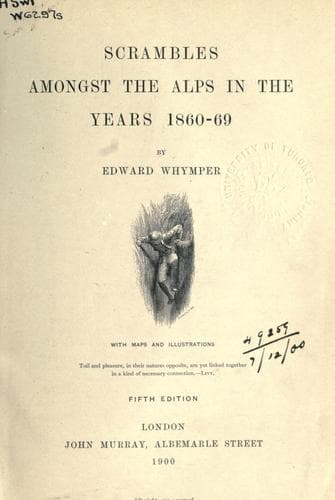
Scrambles Amongst the Alps in the Years 1860-69Whymper, Edward
History
Scrambles Amongst the Alps in the Years 1860-69
Whymper, Edward
Alps -- Description and travel; Mountaineering -- Alps -- History -- 19th century; Mountaineers -- Biography; Whymper, Edward, 1840-1911
Both were bold mountaineers, but Jean-Antoine was incomparably the
better man of the two, and he is the finest rock-climber I have ever
seen. He was the only man who persistently refused to accept defeat,
and who continued to believe, in spite of all discouragements, that the
great mountain was not inaccessible, and that it could be ascended from
the side of his native valley.
The night wore away without any excitement, except from the fleas, a
party of whom executed a spirited fandango on my cheek to the sound of
music produced on the drum of my ear by one of their fellows beating
with a wisp of hay. The two Carrels crept noiselessly out before
daybreak, and went off. We did not leave until nearly seven o’clock,
and followed them leisurely, leaving all our properties in the
cow-shed, sauntered over the gentian-studded slopes which intervene
between the shed and the Glacier du Lion, left cows and their pastures
behind, traversed the stony wastes and arrived at the ice. Old, hard
beds of snow lay on its right bank (our left hand), and we mounted over
them on to the lower portion of the glacier with ease. But as we
ascended crevasses became numerous, and we were at last brought to a
halt by some which were of very large dimensions; and as our cutting
powers were limited, we sought an easier route, and turned naturally to
the lower rocks of the Tête du Lion, which overlook the glacier on its
west. Some good scrambling took us in a short time on to the crest of
the ridge which descends toward the south; and thence up to the level
of the Col du Lion there was a long natural staircase, on which it was
seldom necessary to use the hands. We dubbed the place “The Great
Staircase.” Then the cliffs of the Tête du Lion, which rise above the
couloir, had to be skirted. This part varies considerably in different
seasons, and in 1861 we found it difficult, for the fine steady weather
of that year had reduced the snow-beds abutting against it to a lower
level than usual, and the rocks which were left exposed at the junction
of the snow with the cliffs had few ledges or cracks to which we could
hold. But by half-past ten o’clock we stood on the col, and looked down
upon the magnificent basin out of which the Z’Mutt glacier flows. We
decided to pass the night upon the col, for we were charmed with the
capabilities of the place, although it was one where liberties could
not be taken. On one side a sheer-wall overhung the Tiefenmatten
glacier—on the other, steep, glassy slopes of hard snow descended to
the Glacier du Lion, furrowed by water and by falling stones: on the
north there was the great peak of the Matterhorn,[6] and on the south
the cliffs of the Tête du Lion. Throw a bottle down to the
Tiefenmatten—no sound returns for more than a dozen seconds.
[6] The engraving is made after a sketch taken from the rocks of the
Matterhorn, just above the Col.
How fearful
And dizzy ’tis to cast one’s eyes so low!
Public-domain text, read in full here on John Shaqi.
Reviews
Reviews
No reviews yet
Be the first to share your thoughts on this work.
Join the Discussion
Join the discussion
Sign in to leave a comment or review.
Sign InorCreate an account