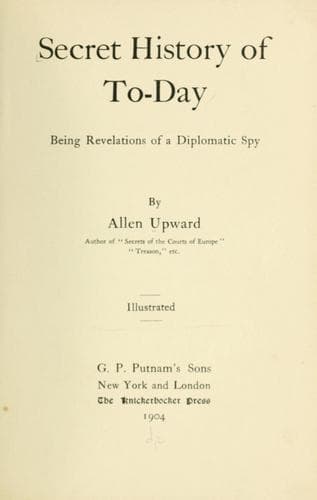
Secret History of To-day: Being Revelations of a Diplomatic Spy — John Shaqi
Secret History of To-day: Being Revelations of a Diplomatic SpyUpward, Allen
History
Secret History of To-day: Being Revelations of a Diplomatic Spy
Upward, Allen
English fiction -- 20th century; Spy stories, English
I listened carefully to these words, scrutinising them for any trace
of a double meaning. It was impossible for me to dismiss entirely
from my mind that suspicion which the story told by Wilhelm II. was
naturally calculated to excite. I asked myself whether the Kaiser was
really in earnest, or whether he was not inviting me, in a delicate
fashion, to extricate him from the consequences of his own rashness,
by putting together some fictitious account of the origin of the
telegram, which might impose on Lord Salisbury.
It was clearly necessary, however, for me to appear to be convinced.
‘May I ask if your Majesty’s suspicions point in any particular
direction?’ I asked, trying to feel my way cautiously. ‘The President
of the Boers is perhaps----’
The Kaiser interrupted me.
‘I do not think Kruger would dare to provoke me by such a trick.
He would know that he would be the first to suffer when it was
found out. No, I am convinced that we must look nearer home for the
traitor.’
Something in the Emperor’s tone struck me as significant.
‘If you could give me any indication of the person----’ I ventured to
throw out.
His Majesty looked at me fixedly as he answered--
‘Does it not occur to you, Monsieur V----, that there is in my Empire
a powerful family, the heads of which seem at one time to have
cherished the notion that the Hohenzollerns could not reign without
them, a family which aspired to play the same part in modern Germany
which was played by the Mayors of the Palace in the Empire of the
Merovingians?’
‘You allude, sire, without doubt, to the Bismarcks?’
‘My grandfather was forced into war with the French by a forged
telegram. There would be nothing surprising in an attempt from the
same quarter to force me into a war with England.’
I had no answer to make to such reasoning. Daring as such a manœuvre
might appear, it was absurd, in the face of historical facts, to
pronounce it improbable.
After a minute spent in considering the situation, I turned to the
question of how the fraud might have been carried out.
It was quite clear to me that such a message could not have gone
over the ordinary wires. The despatches of Emperors are not, as a
rule, handed in over the counter of a post-office, like a telegram
from a husband announcing that he is prevented from dining at home. I
asked the Kaiser to explain to me the system pursued with regard to
Imperial messages.
‘That is a matter about which you will be able to learn more from
the Chancellor than from me,’ was the answer. ‘Foreign despatches go
through the Chancellery, and there is a staff of telegraphists there
to deal with them. The wire goes direct to the Central Telegraph
Office, I believe, from which it would, of course, find its way to
the Cable Company.’
‘Then this fabrication must have been sent from the Chancellery in
the first instance?’ I inquired. ‘It could not have been received at
the Central Office from an outside source?’
Public-domain text, read in full here on John Shaqi.
Reviews
Reviews
No reviews yet
Be the first to share your thoughts on this work.
Join the Discussion
Join the discussion
Sign in to leave a comment or review.
Sign InorCreate an account