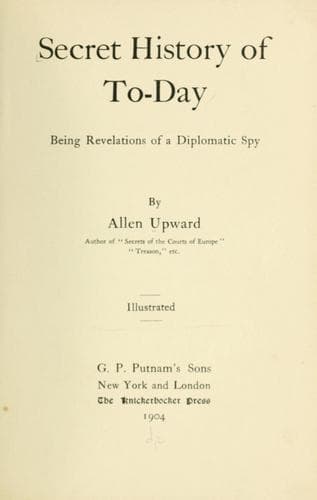
Secret History of To-day: Being Revelations of a Diplomatic SpyUpward, Allen
History
Secret History of To-day: Being Revelations of a Diplomatic Spy
Upward, Allen
English fiction -- 20th century; Spy stories, English
‘It comes to this,’ he cried pathetically, ‘that unless I betray him
you will report to him that I am a traitor!’
‘You should have thought of that before you accepted the money of the
Duke of Heligoland,’ I retorted, naming the Royal exile referred to
above.
The German sighed, and hung his head.
‘The Russian Government is not less wealthy than the Order of
Assumptionists,’ I added.
Finkelstein brightened up again. A man of such mercurial temperament
was most unfit for his position.
As soon as it became a question of terms between us I knew that the
battle was won. The German really hated and feared Russia, like all
his countrymen, and had it been prudent to do so, I should have been
glad to relieve his mind.
It was an easy matter for him to make the required arrangements. A
hint to the commander of the regiment which supplied the Palace guard
that some theft had taken place, and that a detective’s presence was
necessary, was sufficient. At the hour of eleven, the Kaiser’s time
for retiring, I found myself in the uniform of a Prussian soldier,
pacing the corridor which gave access to his Majesty’s cabinet.
Secured from suspicion by the character in which I had entered the
Palace, I lost no time in unlocking the door of the room by means
of a key invented by myself. I must be excused from describing its
mechanism in these pages; but the only lock against which it is
powerless is the familiar letter padlock.
As soon as I was inside I closed the door again. I did not venture
to turn on the electric light, but made use of a dark lantern I had
brought with me, to explore the chamber.
In front of me stood his Majesty’s writing-table, covered with
despatch boxes. I considered it useless to open them, and turned my
eyes round the room in search of some more secret receptacle.
At first no sign of anything of the kind I sought was visible. There
were cupboards, but they were not even locked. The walls were hung
with maps, among which my eye was particularly caught by a chart of
the world on Mercator’s projection, on which the various possessions
of Great Britain were indicated by small red flags attached to pins.
It seemed to me an ominous thing that such a map, so marked, should
be ever before the eyes of the ablest Continental ruler, who was
known to be feverishly at work building a navy fit to contend with
that of England.
In a reflective mood I stepped towards the map and looked at it. The
flag which marked New Zealand had sagged down slightly, as though
less firmly thrust in than the rest. Without stopping to think what I
was doing, I took hold of the pin and pressed it into the wall.
To my surprise I felt a resistance which at once accounted for the
loose position in which I had found the flag. I removed one of the
other pins, and found it went into the wall without any difficulty.
It was therefore clear that at the particular part of the wall
covered by New Zealand there existed some obstacle, probably of a
metallic nature.
Public-domain text, read in full here on John Shaqi.
Reviews
Reviews
No reviews yet
Be the first to share your thoughts on this work.
Elsewhere in the archive
Join the Discussion
Join the discussion
Sign in to leave a comment or review.
Sign InorCreate an account