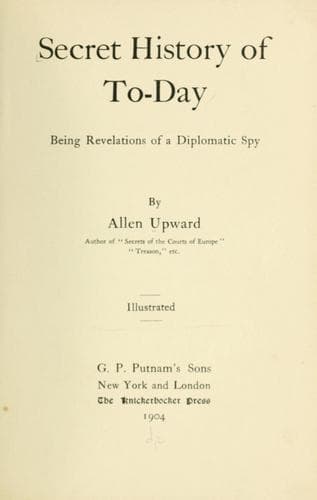
Secret History of To-day: Being Revelations of a Diplomatic SpyUpward, Allen
History
Secret History of To-day: Being Revelations of a Diplomatic Spy
Upward, Allen
English fiction -- 20th century; Spy stories, English
Once convinced of this, I had no doubt as to my next step. I drew
out the whole of the pins in the eastern portion of the chart, and
rolled it back.
I was rewarded by the sight of a dark round patch on the wall-paper,
beneath which I could detect the presence of a metallic disk or knob.
I pressed it boldly, and a square section of the wall opened out on
a hinge, revealing a small cupboard, secured by a black seal showing
the impress of the Emperor’s signet, with which I was sufficiently
familiar.
This discovery placed me in an awkward position. There was no time
for me to counterfeit the seal, and if I broke it, it was evident
that Wilhelm II. must know that his hiding-place had been tampered
with.
The prudence I had shown in dealing with Finkelstein was now
invaluable to me. At the worst the Kaiser would learn that his
secrets were in the hands of a Russian spy, and my real employer
would be unknown. It was this reflection which emboldened me to
proceed.
I broke the seal, opened the cupboard, and found a pile of papers
which I took to the writing-table to look through.
The papers were enclosed in what is styled in Government Departments
a ‘jacket’--a large sheet of paper folded to form a cover. The
outside of this jacket was endorsed in the Kaiser’s well-known
hand--‘_European Zollverein_.’
[Illustration: “‘Arrest that man!’ the Kaiser commanded, without
giving him time to speak.”]
Those words told me all. The daring brain of Wilhelm II. had revived
the idea which the great Napoleon embodied in his famous Milan
Decrees. The whole of the Powers of the Continent were to be united
in a Customs League against Great Britain.
Russia and Austria, I saw, had eagerly welcomed the proposal. Spain
and Turkey, with the Balkan States, were also committed to it. So
were Belgium and Holland, the first in revenge for British criticism
of the Congo Free State, the second on account of the Boer War.
Sweden and Denmark were evidently disinclined to the scheme, but
unable to resist the pressure put upon them. Only three countries
still held out firmly--France, Italy, and Portugal.
The opposition of France seemed to be due partly to the fact that
Great Britain was her largest customer, and partly to dislike of any
proposal coming from Germany. Italy and Portugal seemed to realise
that their own fate was bound up with that of England, and to view
with dread the prospect of weakening the British power.
I had just finished reading the spirited protest of little Portugal,
contained in a private autograph letter from Dom Carlos to the German
Emperor, when the room was suddenly flashed with the full glare of
the electric light. I looked up and saw his Majesty standing before
me, in full uniform, with his sword drawn in his hand.
Public-domain text, read in full here on John Shaqi.
Reviews
Reviews
No reviews yet
Be the first to share your thoughts on this work.
Elsewhere in the archive
Join the Discussion
Join the discussion
Sign in to leave a comment or review.
Sign InorCreate an account