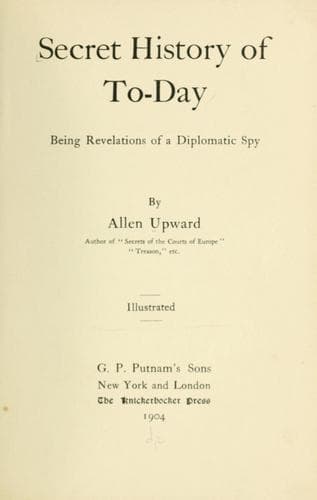
Secret History of To-day: Being Revelations of a Diplomatic SpyUpward, Allen
History
Secret History of To-day: Being Revelations of a Diplomatic Spy
Upward, Allen
English fiction -- 20th century; Spy stories, English
Such an attitude, adopted in order to save France from disruption, is
not without a certain dignity; but it is at the same time terribly
unjust. It is as if France had repeated to the victim of the Devil’s
Isle the memorable words--‘It is better that one man should die for
the people.’
The one person in Europe who is completely ignorant of the true
motives underlying this grim tragedy is without doubt Dreyfus
himself. That taciturn, commonplace figure, suddenly elevated
into the position of criminal, martyr, and hero, was merely the
shuttlecock driven through the air by unseen hands. Even if he was
guilty of writing the celebrated bordereau--a question which the
Court of Rennes decided in the affirmative--he must have done it by
the order of others, given for reasons which he did not comprehend.
It will be remembered that before and during the second trial of
Dreyfus, the strongest efforts were put forth on his behalf by three
foreign Powers--those composing the Triple Alliance. The German,
Austrian, and Italian military attachés, breaking through the
etiquette of their position, disclaimed, each on his personal word of
honour, any dealings with the alleged spy.
Not only so, but I myself sent for the Paris correspondent of a
London newspaper of high standing, and authorised him to inform his
readers that the German Emperor himself was prepared personally to
exculpate the accused from the charge of selling information to
Germany.
This offer, made privately to the French President, was declined for
the same reasons which prompted the Government to hush up the whole
affair. But every thoughtful man will realise that it would not have
been made unless there had been more at stake than the freedom of an
obscure captain.
My own connection with the _Affaire Dreyfus_ dates from the time of
the first trial and sentence, when the theatrical spectacle of the
degradation of the unfortunate officer was the theme of universal
comment. At this juncture I received a visit from Colonel ----, an
officer high in the Emperor’s confidence, and at that time attached
to the German Embassy in Paris.
‘I have come to you,’ he announced, as soon as we found ourselves
alone, ‘by command of his Imperial Majesty the Kaiser.’
I bowed respectfully as I replied--
‘I am deeply honoured by this fresh proof of his Majesty’s
confidence.’
The Colonel regarded me for a moment with some curiosity.
‘You are a sort of spy, are you not?’ he inquired.
I refused to take offence at this blunt question, so natural on the
part of a soldier.
‘Each of us has his own part to play,’ I explained suavely. ‘The
soldier fights with the enemy in the open field; the man of my
profession has to encounter the foes who burrow underground.’
Colonel ---- appeared satisfied.
‘The Kaiser trusts you; that is enough for me,’ he declared. ‘You
will not dare to betray this confidence?’
This time I rose to my feet, stern and contemptuous.
Public-domain text, read in full here on John Shaqi.
Reviews
Reviews
No reviews yet
Be the first to share your thoughts on this work.
Join the Discussion
Join the discussion
Sign in to leave a comment or review.
Sign InorCreate an account