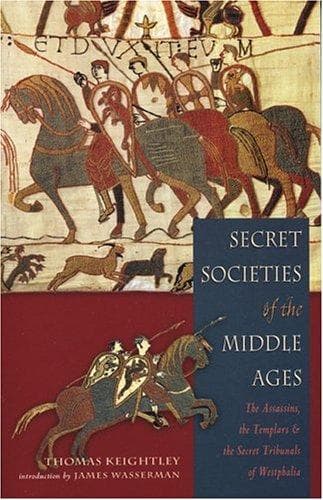
Secret Societies of the Middle AgesKeightley, Thomas
History
Secret Societies of the Middle Ages
Keightley, Thomas
Secret societies
The ancient world presents one secret society of a professedly political
character--that of the Pythagoreans. Of religious ones it might be
expected to yield a rich harvest to the inquirer, when we call to mind
all that has been written in ancient and modern times concerning the
celebrated mysteries. But the original Grecian mysteries, such as those
of Eleusis, appear to have been nothing more than public services of the
gods, with some peculiar ceremonies performed at the charge of the
state, and presided over by the magistrates, in which there were no
secrets communicated to the initiated, no revelation of knowledge beyond
that which was generally attainable. The _private_ mysteries, namely,
the Orphic, Isiac, and Mithraic, which were introduced from the East,
were merely modes employed by cunning and profligate impostors for
taking advantage of the weakness and credulity of the sinful and the
superstitious, by persuading them that by secret and peculiar rites, and
the invocation of strange deities, the apprehended punishment of sin
might be averted. The nocturnal assemblies for the celebration of these
mysteries were but too often scenes of vice and debauchery, and they
were discountenanced by all good governments. It is to these last, and
not to the Eleusinian mysteries, that the severe strictures of the
fathers of the church apply[1].
[Footnote 1: See Lobeck's excellent work "Aglaophamus."]
The history of Pythagoras and his doctrines is extremely obscure. The
accounts of this sage which have come down to us were not written till
many centuries after his death, and but little reliance is to be placed
on their details. Pythagoras was a Samian by birth; he flourished in the
sixth century before Christ, at the time when Egypt exercised so much
influence over Greece, and its sages sought the banks of the Nile in
search of wisdom. There is, therefore, no improbability in the tradition
of Pythagoras also having visited that land of mystery, and perhaps
other parts of the East, and marked the tranquil order of things where
those who were esteemed the wise ruled over the ignorant people. He may
therefore have conceived the idea of uniting this sacerdotal system with
the rigid morals and aristocratic constitution of the Dorian states of
Greece. His native isle, which was then under the tyranny of Polycrates,
not appearing to him suited for the introduction of his new system of
government, he turned his eyes to the towns of Magna Græcia, or Southern
Italy, which were at that time in a highly flourishing condition, whose
inhabitants were eager in the pursuit of knowledge, and some of which
already possessed written codes of law. He fixed his view on Croton, one
of the wealthiest and most distinguished of those towns.
Public-domain text, read in full here on John Shaqi.
Reviews
Reviews
No reviews yet
Be the first to share your thoughts on this work.
Join the Discussion
Join the discussion
Sign in to leave a comment or review.
Sign InorCreate an account