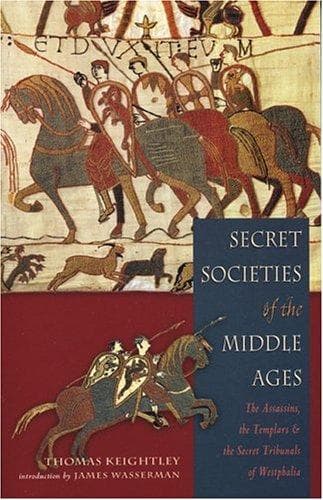
Secret Societies of the Middle AgesKeightley, Thomas
History
Secret Societies of the Middle Ages
Keightley, Thomas
Secret societies
Fulk de Nerra, Count of Anjou, had spilt much innocent blood; he had had
his first wife burnt alive, and forced his second wife to seek refuge
from his barbarity in the Holy Land. The public odium pursued him, and
conscience asserting her rights presented to his disturbed imagination
the forms of those who had perished by him issuing from their tombs, and
reproaching him with his crimes. Anxious to escape from his invisible
tormentors, the count put on him the habit of a pilgrim, and set forth
for Palestine. The tempests which he encountered in the Syrian seas
seemed to his guilty soul the instruments of divine vengeance, and
augmented the fervour of his repentance. Having reached Jerusalem in
safety, he set heartily about the work of penance. He traversed the
streets of the Holy City with a cord about his neck, and beaten with
rods by his servants, while he repeated these words, _Lord, have mercy
on a faithless and perjured Christian, on a sinner wandering far from
his home_. During his abode in Jerusalem he gave abundant alms,
relieving the wants of the pilgrims, and leaving numerous monuments of
his piety and munificence.
Deep as was the penitence of the Count of Anjou, it did not stand in the
way of the exercise of a little pious fraud. By an ingenious device he
deceived the impious malignity of the profane Saracens, who would have
made him defile the holy sepulchre; and the chroniclers tell us that as
he lay prostrate before the sacred tomb he contrived to detach from it a
precious stone, which he carried back with him to the West. On his
return to his duchy he built, at the castle of Loches, a church after
the model of that of the Resurrection at Jerusalem, and here he every
day implored with tears the divine forgiveness. His mind, however, could
not yet rest; he was still haunted by the same horrid images; and he
once more visited the Holy Land, and edified the faithful by the
austerity of his penance. Returning home by the way of Italy, he
delivered the supreme pontiff from a formidable enemy who was ravaging
his territory, and the grateful pope conferred on him in return the full
absolution of all his sins. Fulk brought with him to Anjou a great
quantity of relics, with which he adorned the churches of Loches and
Angers; and his chief occupation thenceforward was the building of
towns and monasteries, whence he acquired the name of _The Great
Builder_. His people, who blessed heaven for his conversion, honoured
and loved him; the guilt of his sins had been removed by the means which
were then deemed of sovereign efficacy; yet still the monitor placed by
God in the human breast, and which in a noble mind no power can reduce
to perfect silence, did not rest; and the Holy Land beheld, for the
third time, the Count of Anjou watering the sepulchre of Christ with his
tears, and groaning afresh over his transgressions. He quitted Jerusalem
for the last time, recommending his soul to the prayers of the pious
Public-domain text, read in full here on John Shaqi.
Reviews
Reviews
No reviews yet
Be the first to share your thoughts on this work.
Elsewhere in the archive
Join the Discussion
Join the discussion
Sign in to leave a comment or review.
Sign InorCreate an account