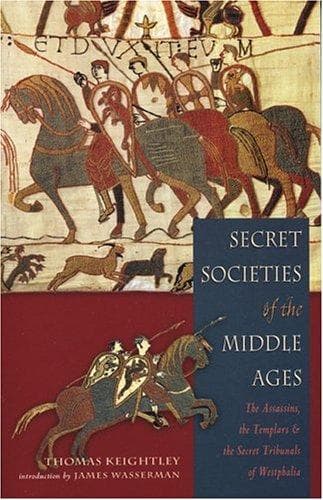
Secret Societies of the Middle AgesKeightley, Thomas
History
Secret Societies of the Middle Ages
Keightley, Thomas
Secret societies
brethren whose office it was to receive the pilgrims, and turned his
face homewards. But Anjou he was never more to behold; death surprised
him at Metz. His body was transferred to Loches, and buried in his
church of the Holy Sepulchre.
These instances may suffice to show what the opinion of the efficacy and
merit of pilgrimage to the Holy Land was at the time of which we write.
We here find convincing proof that in the minds of princes and prelates,
the highest and most enlightened order of society, it was confidently
believed to avail to remove the guilt of crimes of the deepest die. And
let not any one say that the clergy took advantage of the ignorance of
the people, and made it the instrument of extending their own power and
influence; for such an assertion would evince ignorance both of human
nature in general and of the temper and conduct of the Romish hierarchy
at that, and we might almost say at all periods of its existence.
However profligate the lives of many of the clergy may have been, they
never called in question the truth of the dogmas of their religion. Even
the great and daring Gregory VII., in the midst of what appear to us his
arrogant and almost impious assumptions, never for a moment doubted of
the course which he was pursuing being the right one, and agreeable to
heaven. The clergy, as well as the laity, were firmly persuaded of the
efficacy of pilgrimage, and in both the persuasion was naturally
stronger in proportion to the ignorance of the believer. We accordingly
find that vast numbers of all ranks, and both sexes, clergy as well as
laity, annually repaired to the tomb of Christ.
It remains to be explained what the principle was which gave origin to
the idea of the right and justice of recovering the Holy Land, which was
now in the hands of the fanatic Turks, instead of those of the tolerant
Saracens. This cause was, as we have above asserted, the feudal spirit,
that is, the spirit of the age, and not that emanation of it termed
chivalry.
Public-domain text, read in full here on John Shaqi.
Reviews
Reviews
No reviews yet
Be the first to share your thoughts on this work.
Elsewhere in the archive
Join the Discussion
Join the discussion
Sign in to leave a comment or review.
Sign InorCreate an account