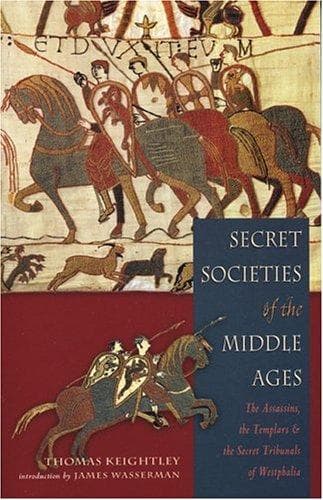
Secret Societies of the Middle AgesKeightley, Thomas
History
Secret Societies of the Middle Ages
Keightley, Thomas
Secret societies
In the 11th century the feudal system was completely developed in France
and Germany, and the modes of thinking, speaking, and acting derived
from it pervaded all the relations of life. From the top to the bottom
of society the mutual obligations of lords and vassals were recognised
and acted upon, and each vassal deemed it a most sacred duty to defend
by arms the honour and property of his superior lord. There was also a
kind of supreme temporal chief of the Christian world acknowledged in
the person of the Emperor of Germany, who was viewed as the successor of
Charlemagne, and the representative of the Roman emperors. The feudal
ideas extended even to the hierarchy, which now put forth such
exorbitant claims to supremacy over the temporal power. The head of the
church was an acknowledged vicegerent of Him who was styled in scripture
Lord of all the kingdoms of the earth. Jesus Christ was, therefore, the
apex of the pyramid of feudal society; he was the great suzerain and
lord paramount of all princes and peoples, and all were equally under
obligation to defend his rights and honour. Such were evidently the
sentiments of the age.
It is hardly necessary to remind the reader that the religion of the
period which we treat of was of a gross and material character, and that
the passions and infirmities of human nature were freely bestowed on the
glorified Son of God. He was deemed to take a peculiar interest in the
spot of land where he had sojourned when on earth, and more especially
in the tomb in which his body had been deposited, and with grief and
indignation to see them in the hands of those who contemptuously derided
his divinity, and treated with insult and cruelty those of his faithful
vassals who underwent the toils and dangers of a distant journey to
offer their homage at his tomb. Nothing could, therefore, be more
grateful to his feelings than to behold the sacred soil of Palestine
free from heathen pollution, and occupied and defended by his faithful
vassals, and no true son of the church could hesitate a moment to
believe that it was his bounden duty to arm himself in the cause of his
lord, and help to reinstate him in his heritage. Here, then, without
having recourse to the romantic principle of chivalry, we have an
adequate solution of the phenomenon of the first Crusade. Here we have a
motive calculated to operate on the minds of all orders, equally
effectual with men of piety, virtue, and wealth, like Godfrey of
Bouillon and Stephen of Chartres, who looked for no temporal advantages,
as with the meanest and most superstitious of the vassals and serfs who
might be supposed to have only sought a refuge from misery and
oppression by assuming the cross. We would not by any means be supposed
to deny that many other causes and motives were in operation at the same
time; but this we deem the grand one. This was the motive which gave
dignity to and hallowed all others, and which affected the mind of every
Public-domain text, read in full here on John Shaqi.
Reviews
Reviews
No reviews yet
Be the first to share your thoughts on this work.
Elsewhere in the archive
Join the Discussion
Join the discussion
Sign in to leave a comment or review.
Sign InorCreate an account