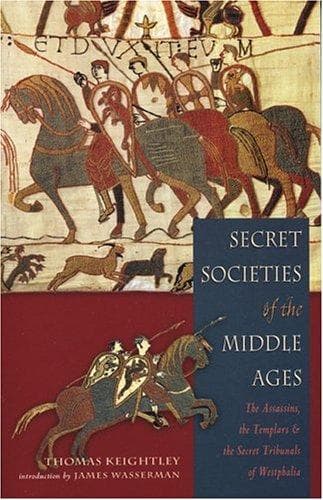
Secret Societies of the Middle AgesKeightley, Thomas
History
Secret Societies of the Middle Ages
Keightley, Thomas
Secret societies
What was the reward of the gallant priest? He was censured by
his diocesan, interdicted the exercise of his ghostly functions, and so
ill-treated in other respects, that he flung off his robes and joined
the Saracens, whose more martial and energetic creed accorded better
with his manly sentiments. When the pilgrims of the first Crusade began
to arrive in such terrific numbers at Constantinople, the Greek emperor
and his subjects could hardly persuade themselves of the possibility of
religion being the actuating cause of such a portentous movement--so
little did religion and deeds of arms accord in their minds!
But with the nations of the West the case was different. In these the
ruling portion, that which gave tone to the whole, were of the Gothic
and Germanic races, whose hardy bands had dashed to pieces the worn-out
fabric of the Western empire. Worshippers in their native forests of
Thor and Odin, and the other deities of Valhalla, who admitted none but
the valiant dead to share in the celestial pork and mead which each day
crowned the board in their lucid abode, their manners, their sentiments,
their whole being was martial, and they infused this spirit into the
religion which they adopted from their Roman subjects. In making this
change in its tone they derived aid from the Jewish portion of the
sacred volume, which has been in all ages abused, by men ignorant of its
character and original use, to purposes of fanaticism and persecution;
and the religion of Christian Europe, from the fifth century downwards,
became of a martial and conquering character. By the sword Charlemagne
converted the pagan Saxons; his successors employed the sword against
the heathen Vends; and by fire and sword Olof Triggva-son spread
Christianity throughout the North. In former times this mode of
conversion had been in a great degree foreign to the Western church; and
persuasion had been chiefly employed in the dissemination of the faith
among the heathen nations.
The religion of the West we thus see was martial; but this spirit alone
would not have sufficed to produce the Crusade which was to interest and
appear as a duty to all orders of men. Here the feudal principle came
into operation, and gave the requisite impulse.
Public-domain text, read in full here on John Shaqi.
Reviews
Reviews
No reviews yet
Be the first to share your thoughts on this work.
Elsewhere in the archive
Join the Discussion
Join the discussion
Sign in to leave a comment or review.
Sign InorCreate an account