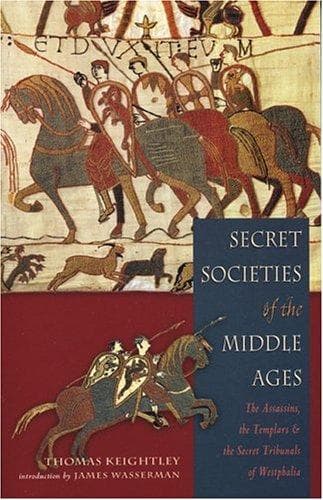
Secret Societies of the Middle AgesKeightley, Thomas
History
Secret Societies of the Middle Ages
Keightley, Thomas
Secret societies
As long as the brotherhood were poor they continued in obedience to the
abbot of Sta. Maria de Latina, and also paid tithes to the patriarch.
But a tide of wealth soon began to flow in upon them. Duke Godfrey,
enamoured of their virtue, bestowed on them his lordship of Montboire,
in Brabant, with all its appurtenances; and his brother and successor,
Baldwin, gave them a share of all the booty taken from the infidels.
These examples were followed by other Christian princes; so that within
the space of a very few years the Hospital of St. John was in possession
of numerous manors both in the East and in Europe, which were placed
under the management of members of their society. The Hospitallers now
coveted a total remission of all the burdens to which they were subject,
and they found no difficulty in obtaining all that they desired. Pope
Paschal II., in the year 1113, confirmed their rule, gave them
permission, on the death of Gerard, to elect their own head, without the
interference of any temporal or spiritual power whatever, freed them
from the obligation of paying tithes to the patriarch, and confirmed all
the donations made or to be made to them. The brotherhood of the
Hospital was now greatly advanced in consideration, and reckoned among
its members many gallant knights, who laid aside their arms, and devoted
themselves to the humble office of ministering to the sick and needy.
The worthy Gerard died in the same year with King Baldwin I. (1118), and
Raymond Dupuy, a knight of Dauphiné, who had become a brother of the
order, was unanimously elected to succeed him in his office. Raymond,
who was a man of great vigour and capacity, drew up a series of rules
for the direction of the society, adapted to its present state of
consequence and extent. From these rules it appears that the order of
St. John admitted both the clergy and the laity among its members, and
that both were alike bound to yield the most implicit obedience to the
commands of their superior. Whether Raymond had any ulterior views is
uncertain, but in the regulations which he made we cannot discern any
traces of the spirit which afterwards animated the order of St. John.
Public-domain text, read in full here on John Shaqi.
Reviews
Reviews
No reviews yet
Be the first to share your thoughts on this work.
Elsewhere in the archive
Join the Discussion
Join the discussion
Sign in to leave a comment or review.
Sign InorCreate an account