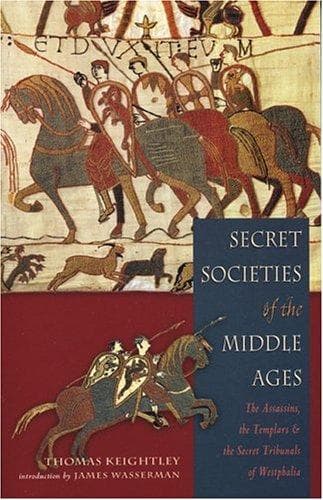
Secret Societies of the Middle AgesKeightley, Thomas
History
Secret Societies of the Middle Ages
Keightley, Thomas
Secret societies
Just, however, as Raymond had completed his regulations there sprang up
a new society, with different maxims, whose example that of St. John
found itself afterwards obliged to adopt and follow. The Holy Land was
at that time in a very disturbed and unquiet state; the Egyptian power
pressed it on the south, the Turkish on the north and east; the Arab
tribes indulged in their usual predatory habits, and infested it with
hostile incursions; the Mussulman inhabitants were still numerous; the
Syrian Christians were ill affected towards the Latins, from whom they
frequently experienced the grossest ill-treatment; the Latins were few
and scattered. Hence the pilgrim was exposed to numerous dangers; peril
beset him on his way from the port at which he landed to the Holy City,
and new perils awaited him when he visited the banks of the Jordan, or
went to pluck his branch of consecrated palm in the gardens of Jericho.
Many a pilgrim had lost his life on these occasions.
Viewing these evils, nine valiant and pious knights resolved to form
themselves into an association which should unite the characters of the
monk and the knight, by devoting themselves to a life of chastity and
piety at the tomb of the Saviour, and by employing their swords in the
protection of the pilgrims on their visits to the holy places. They
selected as their patroness the sweet Mother of God (_La doce Mère de
Dieu_), and their resolution, according so perfectly with the spirit of
the Crusades, which combined piety and valour, gained at once the warm
approbation of the king and the patriarch. In the presence of the latter
they took the three ordinary vows of chastity, poverty, and obedience,
and a fourth of fighting incessantly in the cause of pilgrims and the
Holy Land against the heathen. They bound themselves to live according
to the rule of the canons of St. Augustine, and elected as their first
master Hugh de Payens. The king, Baldwin II., assigned them a portion of
his palace for their abode, and he and his barons contributed to their
support. As the palace stood close by the church and convent of the
Temple, the abbot and canons gave them a street leading from it to the
palace, for keeping their magazines and equipments in, and hence they
styled themselves the Soldiery of the Temple (_Militia Templi_), and
Templars. They attracted such immediate consideration, owing in great
part, no doubt, to the novelty of their plan, that the very year after
their establishment (1120), Fulk, Count of Anjou, who was come on
pilgrimage to Jerusalem, joined their society as a married brother, and
on his return home annually remitted them thirty pounds of silver in
furtherance of their pious objects, and the example of the Count of
Anjou was followed by several other princes and nobles of the West.
Public-domain text, read in full here on John Shaqi.
Reviews
Reviews
No reviews yet
Be the first to share your thoughts on this work.
Elsewhere in the archive
Join the Discussion
Join the discussion
Sign in to leave a comment or review.
Sign InorCreate an account