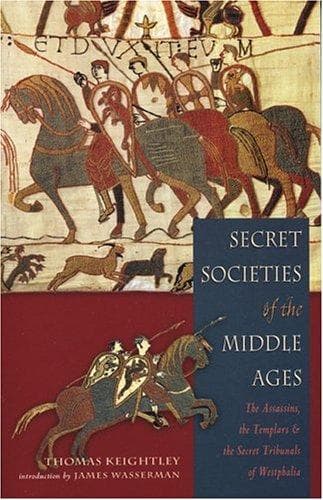
Secret Societies of the Middle AgesKeightley, Thomas
History
Secret Societies of the Middle Ages
Keightley, Thomas
Secret societies
But, like every thing which struggles against the spirit of the age,
such a political system was not fated to endure. While Croton was the
chief seat of Pythagoreanism, luxury had fixed her throne in the
neighbouring city of Sybaris. The towns were rivals: one or the other
must fall. It was little more than thirty years after the arrival of
Pythagoras in Croton that a furious war broke out between them. Led by
Milo and other Pythagoreans, who were as expert in military affairs as
skilled in philosophy, the Crotoniates utterly annihilated the power of
their rivals, and Sybaris sank to rise no more. But with her sank the
power of the Pythagoreans. They judged it inexpedient to give a large
share of the booty to the people; the popular discontent rose; Cylon, a
man who had been refused admittance into the order, took advantage of
it, and urged the people on; the Pythagoreans were all massacred, and a
democracy established. All the other towns took example by Croton, a
general persecution of the order commenced, and Pythagoras himself was
obliged to seek safety in flight, and died far away from the town which
once had received him as a prophet. The Pythagoreans never made any
further attempts at attaining political power, but became a mere sect of
mystic philosophers, distinguished by peculiarities of food and dress.
Ancient times present us with no other society of any importance to
which we can properly apply the term _secret_.
The different sects of the Gnostics, who are by the fathers of the
church styled heretics, were to a certain extent secret societies, as
they did not propound their doctrines openly and publicly; but their
history is so scanty, and so devoid of interest, that an examination of
it would offer little to detain ordinary readers.
The present volume is devoted to the history of three celebrated
societies which flourished during the middle ages, and of which, as far
as we know, no full and satisfactory account is to be found in English
literature. These are the Assassins, or Ismaïlites, of the East, whose
name has become in all the languages of Europe synonymous with murderer,
who _were_ a secret society, and of whom we have in general such vague
and indistinct conceptions; the military order of the Knights Templars,
who were most barbarously persecuted under the pretext of their holding
a secret doctrine, and against whom the charge has been renewed at the
present day; and, finally, the Secret Tribunals of Westphalia, in
Germany, concerning which all our information has hitherto been derived
from the incorrect statements of dramatists and romancers[2].
[Footnote 2: Since the present work was prepared, a translation of Von
Hammer's History of the Assassins has been published by Dr. Oswald
Charles Wood.]
Public-domain text, read in full here on John Shaqi.
Reviews
Reviews
No reviews yet
Be the first to share your thoughts on this work.
Join the Discussion
Join the discussion
Sign in to leave a comment or review.
Sign InorCreate an account