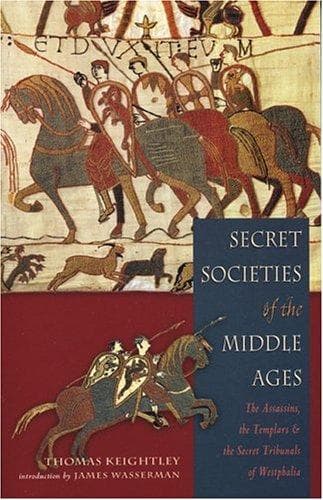
Secret Societies of the Middle AgesKeightley, Thomas
History
Secret Societies of the Middle Ages
Keightley, Thomas
Secret societies
best prosecute his favourite object of breaking the power of the
infidels. The aged monarch fell the following year in the battle of
Fraga, against the Moors; and, negligent of his disposition of the
realm, the nobles of Arragon and Navarre met and chose sovereigns out of
his family. The orders were not strong enough to assert their rights;
and this instance, therefore, only serves to show the high degree of
consideration to which they had so early attained.
[Illustration: Seal of the Templars.]
CHAPTER III.
Return of the Templars to the East--Exoneration and Refutation of
the Charge of a Connection with the Ismaïlites--Actions of the
Templars--Crusade of Louis VII.--Siege of Ascalon--Sale of
Nassir-ed-deen--Corruption of the Hospitallers--The bull, _Omne
Datum Optimum_--Refusal of the Templars to march against
Egypt--Murder of the Ismaïlite Envoy.
In the year 1129 Hugh de Payens, accompanied by 300 knights of the
noblest families in Europe, who had become members of the order, and
followed by a large train of pilgrims, returned to the Holy Land.
Shortly after his arrival, the unlucky expedition to Damascus above
narrated[74], was undertaken, and the Templars formed a portion of the
troops which marched, as they fancied, to take possession of that city.
As has been observed, this is the first occasion on which we find the
Christians in alliance and connection with the Ismaïlites; and as
Hammer, the historian of the last, makes the grave charge against Hugh
de Payens, of having modelled his new society on the plan of that deadly
association, and of having been the chief planner and instigator of the
treacherous attempt on Damascus, we will suspend the course of our
narration, to discuss the probability of that opinion, though in so
doing we must anticipate a little respecting the organisation of the
Order of the Temple.
[Footnote 74: _See_ p. 88.]
Hammer argues an identity between the two orders, as he styles them, of
the Ismaïlites and the Templars, from the similarity of their dress,
their internal organisation, and their secret doctrine; and as the two
societies existed in the same country, and that of the Ismaïlites was
first instituted, he infers that this was the original, and that of the
Templars the copy.
Public-domain text, read in full here on John Shaqi.
Reviews
Reviews
No reviews yet
Be the first to share your thoughts on this work.
Elsewhere in the archive
Join the Discussion
Join the discussion
Sign in to leave a comment or review.
Sign InorCreate an account