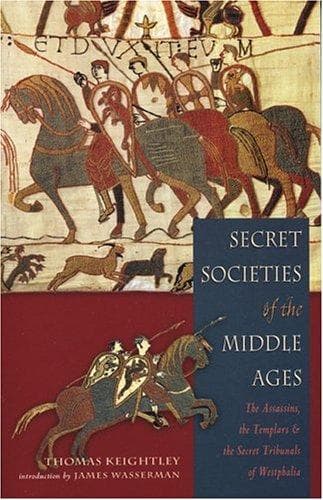
Secret Societies of the Middle AgesKeightley, Thomas
History
Secret Societies of the Middle Ages
Keightley, Thomas
Secret societies
Several knights now assumed the habit of the order, and in a progress
which Hugh de Payens, accompanied by some of the brethren, made through
France and England, he acquired for it universal favour. He did not
neglect the charge, committed to him by the king of Jerusalem, of
invoking aid for the Holy Land, now so hard bested, and his exhortations
were not without effect. Fulk, Count of Anjou, now rejoined his Master
and brethren; but as he had gotten an invitation to repair to Jerusalem,
and espouse the only daughter of the King, he set out before them to the
East.
Hugh de Payens would admit no knight into the order who did not
terminate all his feuds and enmities, and amend his life. Thus, when a
knight, named Hugh d'Amboise, who had oppressed the people of
Marmoutier, and had refused obedience to the judicial sentence of the
Count of Anjou, was desirous to enter the order, he refused to admit him
to take the vows till he had given perfect satisfaction to those whom he
had injured.
Honour and respect awaited the Templars wherever they appeared, and
persons of all ranks were eager to do what might be grateful to them.
When the Templar who came with the seal of Godfrey of St. Omer, as his
credential to the governor of that place, to demand his goods which
Godfrey had given the order, he met with a most favourable reception,
not only from the governor, but from the bishop; and on their applying,
as was necessary in this case, to the Count of Flanders and Alsatia,
that prince was so far from throwing any impediments in the way, that,
in a very short space of time, the buildings which had belonged to
Godfrey were converted into a church and a temple-house. Many Flemish
gentlemen followed the example of Godfrey, and bestowed a part of their
property on the Templars. King Henry I. of England, who met and
conversed with Hugh de Payens in Normandy, was so pleased with his
account of the new order, that he presented him with many rich gifts,
and gave him strong recommendations to the principal of the English
barons. The Emperor Lothaire bestowed in 1130 on the order a large part
of his patrimony of Supplinburg. The old Count Raymond Berenger, of
Barcelona and Provence, weary of the world and of the toils of
government, became a Templar, and took up his abode in the temple-house
at Barcelona; and, as he could not go personally to combat the infidels
in the Holy Land, he continually sent rich gifts to the brethren at
Jerusalem, and he complied rigorously with all the other duties of the
order. In 1133 Alfonso, king of Arragon and Navarre, a valiant and
warlike monarch, who had been victor in nine and twenty battles against
the Moors, finding himself old and without children, made a will, by
which he appointed the knights of the Temple and of the Hospital,
together with the canons of the Holy Sepulchre, to be his joint-heirs,
deeming, perhaps, that the most gallant defenders of the Holy Land would
Public-domain text, read in full here on John Shaqi.
Reviews
Reviews
No reviews yet
Be the first to share your thoughts on this work.
Elsewhere in the archive
Join the Discussion
Join the discussion
Sign in to leave a comment or review.
Sign InorCreate an account