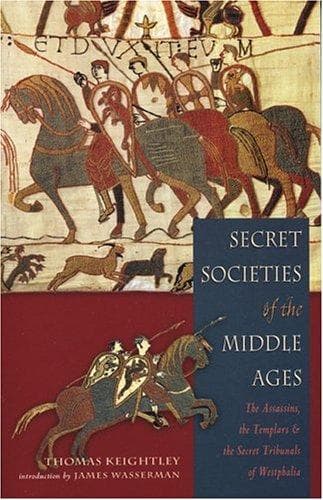
Secret Societies of the Middle AgesKeightley, Thomas
History
Secret Societies of the Middle Ages
Keightley, Thomas
Secret societies
When we reflect on the character of the first crusaders, and
particularly on that of the first Templars, and call to mind their
piety, ignorance, and simplicity, nothing can appear more absurd than to
ascribe to them secret philosophical doctrines of impiety, imbibed from
those whose language they did not even understand, and whose religion
and manners they held in abhorrence, and to suppose that the first poor
knights of the Temple could have had visions of the future power of
their order, and have looked forward to its dominion over the Christian
world. "But this is a common mistake with ingenious men, who are for
ever ascribing to the founders of empires, religions, and societies,
that attribute of divinity which sees from the beginning the ultimate
end, and forms all its plans and projects with a view to it. It is thus
that some would fain persuade us that Mahommed, in his solitary cave at
Mecca, saw clearly and distinctly the future triumphs of Islam, and its
banners floating at the Pyrenees and the Oxus; that Cromwell, when an
obscure individual, already in fancy grasped the sceptre of England; and
that Loyola beheld the members of his order governing the consciences of
kings, and ruling an empire in Paraguay. All such results are in fact
the slow and gradual growth of time; one step leads to another, till the
individual or the society looks back with amazement to the feeble
commencement."
The Templars and the Ismaïlites are mentioned together by history in
only one more relation, that is, on occasion of the tribute paid to the
former by the Syrian branch of the latter, and the murder of the
Ismaïlite ambassador above related[75]. As this act was very probably
committed by order of the Master of the Temple, who, it might be,
doubted the ability or the future inclination of the king to pay the
3000 byzants a year, it testifies but little for any very friendly
feeling between the Templars and the Ismaïlites. Yet Hammer opines that
the 3000 byzants were paid, not as the tribute of the weaker to the
stronger, but by way of pension for the secret services which the
Templars were in the habit of rendering their cause; such, for example,
as refusing on one occasion to join in the expedition against the khalif
of Egypt, the great head of the society of the Assassins.
[Footnote 75: Page 116.]
Public-domain text, read in full here on John Shaqi.
Reviews
Reviews
No reviews yet
Be the first to share your thoughts on this work.
Elsewhere in the archive
Join the Discussion
Join the discussion
Sign in to leave a comment or review.
Sign InorCreate an account